


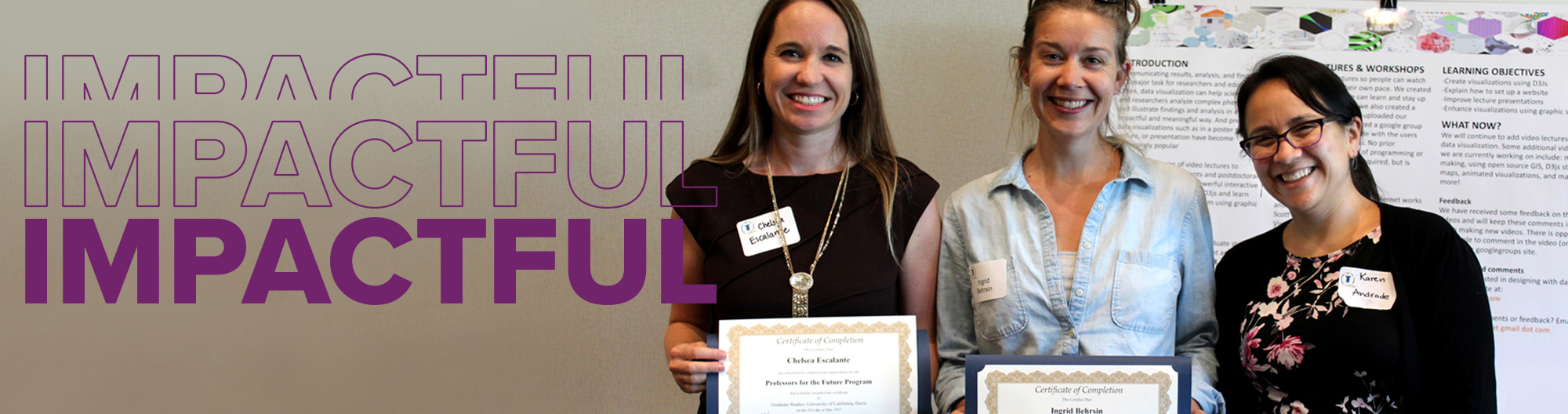
Congratulations to the 2026-27 Professors for the Future Fellows!

| Amanda Agosto Ramos, Plant Biology, Ph.D. CandidateCanvas site of Resources
|
|
| Maddy Frazier, Human Development, Ph.D. CandidateNeurodivergent student workshop series
|
| Augusta Funk, English, Ph.D. CandidateAI and academic writing
|

| Sarah E. Holmes, Chemistry and Chemical Biology, Ph.D. CandidateResource card and pamphlet for managing medical emergencies and chronic conditions
|

| Akshaya Karthikeyan, Biochemistry, Molecular, Cellular and Developmental Biology, Ph.D. CandidateMedia, misinformation, and expression workshop series
|
|
| Katrina Katzenbach, German , Ph.D. CandidateCourse development and scholarly publishing events
|

| Stephanie Martinez-Beltran, Microbiology , Ph.D Candidate.Monthly wellness monthly video content
|

| Sabujkoli Mukherjee, History , Ph.D. CandidateCareer readiness for international grads and postdocs
|
|
| Samuel A. Nelson, Music, Ph.D. CandidateGR-CCC peer mentoring
|

| Taylor Pullan, Biochemistry, Molecular, Cellular and Developmental Biology, Ph.D. CandidatePeer mentoring for queer GR in STEM
|

| Larissa Saco, Sociology , Ph.D. CandidatePublic communications workshop series
|
|
| Ishana Shukla, Ecology , Ph.D. CandidateGuiding UG to research opportunities towards GR pipeline
|

| Mingrui Wen, Comparative Literature, Ph.D. CandidateMaster teachers and professors of teaching panel series
|

| Brandi Goss Ph.D., Center for Watershed Sciences, Postdoctoral ScholarNeurodivergent GR career development
|

| Rohith Vulchi, Ph.D., Plant Sciences, Postdoctoral ScholarStakeholder relations for applied projects
|

| Connie Tsz Fai Wong, Soils and Biochemistry, PhD CandidateFostering a sense of belonging in higher educationOur project is a multi-faceted approach to fostering a sense of belonging within our graduate and postdoctoral community in non-traditional and creative waysby1) Increasing access to resources for neurodivergent students, 2) facilitating connection through food and culture, and 3) creating an inclusive social space where grad students and postdocs can share. |
Prior Professors for the Future Fellows
- 2025-26
Ece Goktayoglu, Chemical Engineering, PhD Candidate
Shaping Futures: Women in Academia Share their Journeys
Women in Academia Share Their Journeys was a professional development initiative aimed at supporting women in academia through conversations about academic careers, inclusion, and leadership. The project created opportunities for participants to learn from successful women scholars representing diverse backgrounds and experiences. The project featured a Women in Academia panel discussion and a screening of Picture a Scientist, which addressed topics such as career planning, work-life balance, gender bias, and discrimination in academia. Together, these events fostered meaningful dialogue, increased awareness of challenges faced by women in academia, and helped participants build supportive networks.
Sophie Gretler, Pharmacology/Toxicology, PhD Candidate
Shaping Futures: Women in Academia Share their Journeys
This project was intended to address the biases and inequities that women face throughout their career in academia. Within academia women are still underrepresented, particularly at higher levels and within historically male-dominated fields such as STEM. As female representation is increasing, our group wanted to draw attention to how the issues that women face is changing and what biases and hurdles they can expect to face in academia. Our project consisted of a two-part series to promote awareness, foster support, and facilitate productive discussions. The first part of the series was a panel session with women professors of diverse backgrounds where we asked structured questions focusing on the following four topics: Launching an academic career, balancing family and academia, addressing gender bias, and career planning. For the second part of our project, we held a screening of the 2020 documentary film “Picture a Scientist”. This film follows the stories of three researchers describing the discrimination they have faced in the STEM field and prompted a stimulating discussion with fellow graduate students. The enthusiastic engagement of our peers in both our panel and film events highlights the importance of discussing and supporting women throughout their academic career.
Sara Hariri, Biochemistry, Molecular, Cellular and Developmental Biology, PhD Candidate
Shaping Futures: Women in Academia Share their Journeys
Christian Bernal-Cordoba, Animal Biology, PhD Candidate
Bridging the Gap: Supporting Hispanic/Latin Students on the Path to Graduate and Professional School
Rationale: Community college students, particularly Hispanic/Latine, first-generation, and historically underrepresented students in STEM, often face barriers to accessing research opportunities and graduate education pathways. These barriers include limited exposure to research environments, uncertainty about how to prepare competitive application materials, and limited access to mentorship and professional networks. Through the Professors for the Future program, this project aimed to make research and graduate education more visible, accessible, and actionable for Woodland Community College students.
Objectives: The objectives were to support community college students in understanding research pathways, preparing application materials, and building confidence in pursuing research and graduate education. The project also aimed to establish a foundation for continued collaboration between UC Davis PFTF fellows and Woodland Community College MESA.
Methods: In collaboration with Maritza Miramontes, Joaquín Mogollón-Santiana, and Woodland Community College MESA, we developed and delivered two workshops. The first workshop focused on the MESA Undergraduate Research Scholars Program (MURSP) application, including CV/resume preparation, personal statements, letters of recommendation, and common application mistakes. The second workshop focused more broadly on research pathways, including how to find research labs, contact faculty or graduate students, understand graduate school options, and identify transferable skills from academic, work, and volunteer experiences.
Results: The first workshop reached 6 students in a hybrid format and provided practical guidance for preparing applications to MURSP, which provides summer research opportunities for WCC MESA students. The second workshop reached 7 students (3 in person and 4 online) and generated strong engagement, particularly during the Q&A. Students asked questions about requesting letters of recommendation, finding labs, becoming competitive with limited
experience, navigating paid and unpaid research opportunities, balancing research with work and family responsibilities, and writing personal statements authentically. Partner feedback from WCC MESA highlighted the value of practical examples, guidance on contacting labs, and support for students who may hesitate to apply because they feel underqualified.
Discussion / Conclusion: This project showed that building research pathways requires more than sharing information. Students benefit from exposure, mentorship, and practical tools and examples that help them understand how to begin. The workshops created a space for students to ask honest, practical questions and helped strengthen a relationship-based outreach model between UC Davis graduate students and Woodland Community College MESA.
Next Steps: Future work could include developing reusable resources such as CV/resume templates, personal statement prompts, faculty outreach email templates, and research opportunity search guides. This project also provides a foundation for future PFTF cohorts to continue and expand community college outreach in partnership with WCC MESA.
Maritza Miramontes, Psychology, PhD Candidate
Bridging the Gap: Supporting Hispanic/Latin Students on the Path to Graduate and Professional School
Through our workshops we were able to present to 13 Woodland Community College students, we coordinated with two MESA staff and interacted with one faculty member at Woodland Community College who also shared needs for the students. Next steps would be to maintain this partnership with Woodland Community College to expand the
workshops to a series of smaller sessions on each subtopic of interest (i.e., personal statement, CV/resume) to be able to not only provide the information but to also help the students draft relevant materials. Additional steps are to connect with SACNAS (Society for Advancement of Chicano/Hispanics and Native Americans in Science) to expand our reach
and build stronger and long lasting outreach.
Joaquin Mogollon, Chemical Engineering, PhD Candidate
Bridging the Gap: Supporting Hispanic/Latin Students on the Path to Graduate and Professional School
For this project, our group focused on supporting undergraduate transfer students at UC Davis who often enter with limited research experience and misconceptions about graduate and higher education. In partnership with MESA at Woodland Community College, we identified key areas where students needed guidance, including applying to summer research programs, writing personal statements, requesting letters of recommendation, finding mentors and research opportunities, and building confidence in their research skills.To address these needs, we held two workshops. The first prepared students for summer research opportunities by covering CV/resume development, personal statement writing, and strategies for requesting letters of recommendation. The second explored research pathways, including graduate degree options, finding and contacting research labs, and recognizing transferable skills gained through work and student organizations.
Through these workshops, we engaged directly with Woodland Community College students and gained a deeper understanding of their challenges. Students expressed a need for additional support in securing research opportunities, navigating the process of asking for letters of recommendation, getting started in research with little prior experience, understanding paid versus unpaid research positions, and balancing academic, work, and family responsibilities.
Overall, we reached 13 Woodland Community College students, collaborated with two MESA staff members, and connected with a Woodland Community College faculty member who reinforced these student needs. Moving forward, we hope to continue this partnership by expanding the workshops into a series of smaller, hands-on sessions focused on individual topics such as personal statement writing and CV/resume development. We also plan to partner with SACNAS (Society for Advancement of Chicanos/Hispanics and Native Americans in Science) to broaden our outreach and strengthen long-term support for community college students pursuing research opportunities.
Babatunde Anoba, History, PhD Candidate
Public Communication Training
The Scholarly Public Communication Program at UC Davis GradPathways was designed to equip graduate students and postdoctoral scholars with the skills to communicate their research to general audiences in clear, accessible, and engaging ways. Developed in collaboration with the UC Davis Writing Center, the program guided participants through a public writing course and a custom-designed online module introducing principles of writing for non-academic audiences. Organizer salso engaged in a radio feature component with the campus radio station, broadening their reach beyond print. The strongest research communication pieces are being published on the GradPathways Institute website, amplifying the public impact of UC Davis scholarship.
Jonny Berlingeri, Plant Sciences, PhD Candidate
Public Communication Training
Graduate students often lack structured opportunities to translate specialized research into accessible public communication. To address this gap, our group developed a research communication training program for Ph.D. students and postdoctoral scholars at University of California, Davis. The program combined training workshops with iterative feedback sessions, culminating in the production of public-facing communication products published through the UC Davis Graduate Pathways Institute webpage and/or aired on KDVS 90.3 FM. Final products focused on translating research findings into language accessible to broad audiences. Through this initiative, the program supported early-career researchers in developing research communication skills, expanding the public visibility and reach of their research, and fostering interdisciplinary dialogue beyond traditional academic settings.
Danyelle Forte, Horticulture and Agronomy, PhD Candidate
Public Communication Training
The Scholarly Public Communication Program (SPCP) is a skills-building program for Ph.D. students and postdoctoral scholars at the University of California, Davis. The program strengthens participants' ability to communicate their scholarship to broad, non-specialist audiences through written and oral media. SPCP provides structured training, mentorship, and individualized feedback on research briefs while creating opportunities for participants to share their work through a university-hosted webpage and the student radio station, KDVS.
Through a combination of self-paced instructional resources, peer mentoring, editorial support, and interdisciplinary collaboration, the program helps participants develop confidence and proficiency in public scholarship. By promoting accessible communication of research, SPCP expands community engagement with emerging scholarship and lays the groundwork for a resource hub that could support researchers in reaching diverse audiences across disciplines.
Shannon Klotz, Psychology, PhD Candidate
Public Communication Training
Joanna Rothwell VM Population Health and Reproduction, Postdoctoral Scholar
Public Communication Training
Research Remix: Scholars on Air is a radio interview series on KDVS, UC Davis's student station, cohosted with Jonny Berlingeri. The program runs on Friday mornings from 8-9 am. Graduate students and postdocs share their research in hour-long conversations aimed at general audiences. Seven shows have aired so far, with more planned through the summer. Each interview is paired with pre-interview coaching on storytelling and radio communication. Topics emphasize research relevant to local communities, such as agriculture, and the show draws audience engagement through social media and call-in questions. The program aims to amplify diverse voices, connect UC Davis research with the public, and give interviewees a portfolio piece for their professional development.
Alejandra Cano, Native American Studies, PhD Candidate
A Three Sisters Approach to Graduate Student Educational Effectiveness
Impostor feelings are a shared experience among graduate students and postdoctoral scholars, which can negatively impact wellbeing. Recognizing that dominant academic cultures and expectations often foster these feelings of self-doubt can help emerging scholars understand that we are not alone in this experience. Therefore, this project developed and facilitated a three-part workshop series designed to help participants deconstruct impostor feelings not as self-deceit but as part of a structural issue. The goal was to build practices and acquire tools for personal and professional growth.The series approached impostor feelings through three complementary dimensions. The first workshop focused on the cognitive aspects of impostor feelings, where participants identified their critical inner voice. With the help of CAN counselors, participants explored evidence-based strategies for reframing negative thought patterns. The second workshop focused on embodiment, examining how stress, anxiety, and self-perception manifest physically. Facilitated by Professor Joe Dumit, the embodiment workshop provided a space to cultivate presence and self-awareness, while highlighting the importance of rest. The third workshop focused on public speaking and professional communication. By integrating cognitive, embodied, and communication-based approaches, the series offered a holistic framework for addressing self-doubt while supporting participants' community and professional development.
The project advances the mission of Professors for the Future by fostering inclusive professional development, strengthening participants' sense of belonging within academic communities, and equipping future scholars with tools to succeed as researchers, educators, and leaders. Beyond addressing impostor feelings itself, the series created opportunities for community building and open dialogue around challenges that are often experienced individually but shared collectively across graduate education.
Melissa Gomes, Linguistics, PhD Candidate
A Three Sisters Approach to Graduate Student Educational Effectiveness
The Three Sisters model is based on Indigenous American agricultural practices, in which three plants (corn, beans, and squash) are planted together in a shared space. They work synergistically to nourish each other and provide a sustainable, nutritional diet. Our project used a similar model to focus on different aspects of higher education but all contribute to the larger goal of equipping graduate students to become more effective educators. Sister Project 1 focuses on the teaching graduate students do inside the classroom as teaching assistants. Sister Project 2 focuses on the role of graduate students outside of the classroom as researchers training undergraduates to be the next generation of graduate researchers. Sister Project 3 focuses on combatting impostor syndrome in graduate students so that they can show up in these roles as the full embodiment of their diverse experiences and identities. My contribution was toward Sister Project 2: Guiding Community College Students Toward Research Opportunities. Liz Gallegos and I collaborated with MESA (Mathematics, Engineering, Science Achievement) program at American River College to guide community college students through the process of applying to the Summer Research Early Identification Program (SR-EIP), run by the Leadership Alliance. We ran four-part workshop series over the course of the month of April 2026:
1. Introduction to Research & The Leadership Alliance Program
2. Writing Your Statement of Purpose
3. Application Peer Review & Requesting Recommendation Letters
4. How to Apply to Grad School & Graduate Student Q&A
I utilized my expertise as a UCD writing instructor to guide students through the written portions of the application in Workshop #2 and conduct peer review in Workshop #3. I also served on the panel for Workshop #4. We had a small, but committed group of students participate in the workshop series and I am happy with the ways in which we were able to make research opportunities more accessible to these students.
Liz Reyes Gallegos, Entomology and Nematology, PhD Candidate
A Three Sisters Approach to Graduate Student Educational Effectiveness
Exposure to the research process and access to mentors are crucial for becoming a successful applicant to graduate school and eventually, a successful graduate student. However, accessing research training and mentoring can be challenging for students whose parents did not attend college, are of low-income backgrounds, or belong to underrepresented populations in STEM. This project addressed this need by guiding students from the Mathematics, Engineering, Science, Achievement (MESA) Program at American River College in their application to the Summer Research Early Identification Program (SR-EIP), run by the Leadership Alliance. We held a four-part workshop series that covered:
1. Introduction to Research & The Leadership Alliance SR-EIP
2. Writing Your Statement of Purpose
3. Application Peer Review & Requesting Recommendation Letters
4. Graduate Student Q&A
Through this initiative, we aimed to expand access to paid research internship opportunities and increase the level of graduate school preparedness of students from underrepresented backgrounds. We assessed the goals of our project through an anonymous evaluation form administered at the end of the series.
Attendees reported an increased understanding of how research experience aligns with their academic and career goals, as well as an increased sense of confidence in approaching different elements of the application process independently. Student feedback also highlighted the value in articulating classroom experiences that help them develop transferable skills for research internships. Finally, students appreciated speaking with current graduate students to gain a better perspective on graduate school demands and day-to-day activities.
Davrina Rianda, Nutritional Biology, PhD Candidate
A Three Sisters Approach to Graduate Student Educational Effectiveness
At UC Davis, graduate Teaching Assistants (TAs) typically teach undergraduate students as part of their funding arrangements. However, many TAs lack formal training and may experience insecurity about their teaching capabilities. Serving as a TA in the U.S., where intercultural competence is essential, can add to the challenges of delivering effective instruction. Therefore, adequate training for TAs at UC Davis is critical to ensure high-quality undergraduate education, enhance teaching effectiveness, and reduce TA’s anxiety associated with teaching experiences.
TeachUp is a training program for TAs that combines peer mentoring (LinkUp & PairUp) and workshop series (StepUp) to build teaching confidence and adaptability in the U.S. academic, intercultural setting. The program is designed for first-time TAs, as well as both domestic and international TAs. The workshop series covers topics of activating lectures, deconstructing imposter syndrome, and utilizing theater and performance technique for teaching. First-time TAs are paired with more experienced TAs who serve as mentors; they share strategies and advice, and provide support as active listeners to their less experienced peers.
For its pilot implementation, TeachUp involved nine mentor–mentee pairs across multiple graduate groups and departments. Before the program, mentees reported the lowest confidence in responding to unexpected student questions and adjusting their teaching in the moments, suggesting that first-time TAs may especially benefit from training that goes beyond content preparation and focuses on real-time decision-making and adaptive teaching practices. After program completion, TA mentees highlighted the value of
observation-based learning, peer connection, and receiving detailed, actionable feedback from mentors.
Mentees reported an overall 30% increase in teaching confidence and 80% expressed interest in becoming future mentors. Together, these findings suggest that TeachUp may be a promising peer-based model for improving teaching self-efficacy and building a pipeline of future graduate student teaching mentors.
Christofer Brothers, Neurobiology, Physiology, PhD Candidate
Fostering a sense of belonging in higher education
Nyx Moriarty, Psychology, PhD Candidate
Fostering a sense of belonging in higher education
Elizabeth Sahagun, Internal Medicine, Postdoctoral Scholar
Fostering a sense of belonging in higher education
Connie Wong, Soils and Biochemistry, PhD Candidate
Fostering a sense of belonging in higher education
The Grad Table: Accessible Cooking, Culture, and Community was developed as a community-building initiative aimed at fostering belonging among graduate students and postdoctoral scholars through food, culture, and shared experiences. As part of the broader Professors for the Future Program theme of fostering belonging in higher education, the project invited participants to share recipes that supported them during demanding periods of academic life. The initiative focused on cultural comfort foods, budget-friendly meals, and recipes that were practical and meaningful to the participants. By centering food as a cultural connector, the project sought to affirm the diverse backgrounds and experiences represented within the graduate student and postdoctoral community while also encouraging connection and community care.
The recipe submission initiative took place during March 2026 and was promoted through the GradPathways Institute newsletter, Graduate Student Association weekly announcements, and campus community listservs, including Eco-Social networks. Graduate students, postdocs, and affiliates were encouraged to submit recipes that they enjoyed, relied on during busy academic periods, or associated with comfort and well-being. A total of 23 recipes were collected and compiled into a digital cookbook intended to be shared within the UC Davis graduate student and postdoctoral communities. In addition, recipe cards featuring a few simple and accessible meals were created and distributed as resources at the Neurodivergent Resource Fair held on April 17, 2026. These efforts helped create an inclusive and community-oriented resource centered on food, culture, and belonging.
- 2024-25
- Laurinne Balstad, Environmental Science and Policy, Population Biology, PhD Candidate
Elmira Louie, Comparative Literature, PhD Candidate
Chat with an Editor: De-mystifying Academic Journal Publishing
This initiative was designed to address a critical component of the “hidden curriculum” in graduate education: understanding and navigating the world of academic publishing. While the importance of publishing in peer-reviewed journals is frequently emphasized—especially for those pursuing academic careers—graduate students often receive little to no guidance on how these journals function. This lack of transparency can lead to missed opportunities, increased stress, and delays in degree completion, ultimately making students less competitive for postdoctoral and faculty positions. To tackle this issue, the project introduced a structured workshop series aimed at demystifying academic publishing. Two discipline-specific sessions were held—one focused on the Humanities and the other on the Biological Sciences. Each workshop featured a panel of editors from prominent academic journals who shared insights on topics such as the peer review process, the role of editors, special issues, selecting appropriate journals, and responding to reviewer feedback. Following the panel discussions, attendees engaged in extended Q&A sessions, allowing early-career scholars to ask candid questions and receive direct guidance from experienced editors. These conversations fostered a collaborative environment and helped participants build the confidence and skills necessary to navigate the publishing landscape more effectively. To ensure the information remained accessible beyond the workshops, the project team developed a set of infographic guides and an FAQ document covering key aspects of academic publishing and writing book reviews. These resources, created in collaboration with a PFTF partner, are now available on the UC Davis Graduate Studies GradPathways website, providing ongoing support for graduate students and postdocs seeking to publish their work.
Colton Baumler, BMCDB, PhD Candidate
The Modern, Practical Scholar
The struggle of reading without clear guidance extended across the core pillars of graduate education: literature review, teaching, and data visualization. The absence of a standardized, accessible approach to managing these domains led to a search for practical solutions. Through conversations with colleagues and mentors, a systematic method eventually emerged—one that not only alleviated the burden but also inspired a desire to share these insights with others. This led to the creation of “The Modern, Practical Scholar” a multi-session curriculum designed to combat choice paralysis and cognitive overload. The program introduces scholars to the most effective free, open-source, and community-driven tools available for academic work. Through hands-on instruction, it offers structured workflows for literature discovery, management, reading, and curation tailored to specific scientific subfields. The result is an accessible, evolving, and continuously updated workshop series that equips scholars at all career stages with applied technological skills to enhance their research practices. Ultimately, the project delivers a flexible and customizable framework that fills a critical gap in early graduate education: foundational knowledge management for sustainable and effective scholarship.
Erika Milagros Bueno, Entomology and Nematology, Postdoctoral Scholar
Nicole Halmai, Genome Center, Postdoctoral Scholar
Nicole Weronika Korzeniecki, Animal Behavior, PhD Candidate
Building Bridges for Academic Success: Strengthening the UC Davis First-Gen Community Across Academic Levels
First-generation scholars face tangible challenges, such as imposter syndrome, a lack of belonging, and a lack of familiarity with university culture, which can become exacerbated by an isolating, academic environment. Despite 37% of UC Davis undergraduates being first generation college students (Fall 2024), support and programming through the First-Generation Initiative (FGI) has dwindled overtime. This is especially true for first-generation graduate students and postdoctoral scholars. To address these issues, our PFTF fellows project group collaborated with the FGI to host a First Gen Spring Forum. The primary goals of this forum were to provide resources, networking opportunities, and solicit feedback on what our UC Davis first-gen community wanted to see moving forward for the FGI. All first-gen faculty, postdocs, and graduate students were invited to participate in this forum, where we networked over lunch, heard and related to the experiences of our first-gen panel members, and brainstormed as a community about our challenges, sources of support, and next steps.
The First Gen Spring Forum was highly successful in fostering a sense of community. The majority of attendees were graduate students, followed by faculty, postdocs, and staff, all of whom gave the forum high ratings. Remarkably, 83% of participants reported feeling more connected to the first-gen community afterward. Attendees especially appreciated the brainstorming activities and opportunities to share their experiences. Many expressed that the forum helped them realize their feelings of insecurity and not fitting in were common among first-generation students, and that it highlighted a strong need for connection with other first- gen scholars and allies. From the community brainstorming session, we identified the hidden curriculum of academia as the greatest challenge for first-gen graduate students. For first-gen postdocs and staff, allyship, finances, and the hidden curriculum of academia were equally identified as challenges. Faculty identified allyship to be one of their greatest challenges. At the same time, graduate students felt the greatest support through their mentoring and ally networks. Postdoc and staff expressed feeling supported by financial and funding resources, while faculty experienced support through community building. Interestingly, faculty viewed institutional support as both a challenge and a method of support. Overwhelming for both faculty and graduate students, community building was identified as the most important priority for continuing to support the first-gen community. Postdocs and staff believed greater awareness and access to resources and support for navigating the hidden curriculum of academia were the most important issues to focus on for supporting the first-gen community at Davis. Moving forward, we plan to increase the visibility of all academic levels of the first-gen community. The feedback from this forum will inform future FGI programming that will allow for long-term support of the first-generation experience at UC Davis.
Zarah Deutsch, Animal Biology, PhD Candidate
Diana Malarchik, Anthropology, PhD Candidate
Publish or Parent? Navigating the Academic Family Building Process from Planning to Progeny
Balancing graduate school and family planning can be overwhelming—especially for women and pregnant individuals, who often face disproportionate challenges. To support student parents at UC Davis, a multipart seminar series was launched to provide clear, accessible information and build community.
The series featured two sessions:
- Legal Rights & Protections: Covered Title IX and leave benefits with campus experts.
- UC Davis Resources Highlighted programs like lactation support, child grants, and student parent services.
Each seminar included expert presentations followed by interactive Q&A panels. While attendance was modest, the impact was significant. One student shared that the seminar gave them the confidence to seek support during a difficult pregnancy—proof that even small efforts can make a lasting difference.
Quimby Lee, Neuroscience, PhD Candidate
John Paulus, Neuroscience, PhD Candidate
Neurodivergence in Academia Seminar Series: Supporting Students through Higher Education
Neurodivergent students remain underrepresented and underserved in graduate programs, often facing unique challenges related to stigma, masking, and lack of adequate support. As part of the Professors for the Future (PFTF) program, this project aimed to raise awareness of these challenges and highlight the support systems available to help neurodivergent students thrive in academia. Two public seminars brought together students, faculty, and staff. The first seminar, "Neurodivergent Researchers Share Their Experiences," featured three graduate students and postdocs with neurodivergence who spoke candidly about navigating higher education. The second seminar, "Services and Resources Offered for Neurodivergent Undergraduate and Graduate Students," highlighted support available through the Student Disability Center, Counseling Services, and Accessible Assistive Technology. Both events encouraged open dialogue, normalized help-seeking, and emphasized the importance of mentorship, community, and informed counseling. Through these efforts, we hope to promote a more inclusive academic environment where neurodivergent students feel empowered to advocate for themselves and supported in their pursuit of success.
Sabrina Mederos, Animal Behavior, PhD Candidate
Identifying and Advocating for the Expansion of Resources for Commuter Students at UCD
Commuter students—those who travel regularly from outside the city to attend UC Davis—face unique challenges that can hinder their access to campus resources, sense of belonging, and academic success. Recognizing these barriers through personal experience, Sabrina Mederos initiated a project aimed at addressing the specific needs of this often-overlooked population. To ensure the project was grounded in real student experiences, Sabria drew on multiple sources: data from the 2023–2024 UC Davis Campus Travel Survey, outreach to student organizations and campus departments, direct conversations with commuter students, and collaboration with UC Davis Transportation and Parking Services (TAPS). This comprehensive approach helped identify both existing support systems and those that have been discontinued, such as the GoClub. The result was a tri-fold commuter resource pamphlet, designed using UC Davis branding and colors, and intended for distribution across campus hubs like the Transfer and Reentry Center and the Graduate Student Association. The pamphlet serves as a practical and affirming guide to help commuter students navigate campus life more easily. This initiative is envisioned as the foundation for a broader, ongoing effort. Future goals include developing an annually updated guide informed by continued student feedback and advocating for the revival or redesign of TAPS programs that previously supported commuting. Ultimately, the project seeks to reduce the daily stress of commuting and foster a stronger sense of connection, visibility, and support for commuter students at UC Davis.
Emmanuel Momoh, Geography, PhD Candidate
Cultivating Cultural Connectedness and Food Sovereignty Among International Students
When international students from low and middle-income countries relocate to high-income ones, they experience an abrupt shift in their food and sociocultural environment. This shift entails a notable transition from a more traditional, locally-based food environment to one that is modern and industrialized (Terragni e t al., 2014; Ibe-Lamberts, 2016; Paxton et al., 2016; Akingbule et al., 2021; Osei- Kwasi et al., 2023). As a result, international students often face difficulties in accessing culturally appropriate foods. The inability to eat familiar food impacts diet-related health and disrupts socio- emotional and cultural systems (Smith & Franzen-Castle, 2012; Okafor et al., 2014; Almohanna et al., 2015; Wu & Smith, 2016; Agyemang & van den Born, 2019). This is because food is cultural, and food culture forms a vital part of people’s identity, heritage, and how they maintain their health and sense of food security. Preliminary findings from UC Davis suggest that 81.8% of student respondents (n= 33) perceive access to cultural food from their home country as important to their food security and well-being. Despite the well-established importance of cultural food in maintaining food security, most food security initiatives and research simultaneously focus on access to healthy/nutritious food, ignoring the cultural perspectives of food security. Besides food, there is also a deviation from the more tight-knit, interpersonal communities that international students are accustomed to. So, they often lack a sense of belonging in their new environment, resulting in feelings of isolation and impacting their overall well-being.
Rachel Moreno, Microbiology and Immunology, PhD Candidate
Eleanor Pressman, Animal Biology, PhD Candidate
Thinking Big: How to use creative thinking to envision a research symposium
This was a half-day mini symposium that took place on May 2nd, 2025, from 1–5 PM in Walker Hall. There were two keynote sessions and three breakout sessions. The central topic for all the sessions was creativity and what it looks like in science, especially at the graduate level. The first keynote was about design thinking in science, followed by three breakout sessions on different strategies that students can use to enhance creativity, the traits of a high-functioning multidisciplinary team, and how novices can uniquely contribute to scientific research. The symposium ended with a faculty panel, featuring members from both academia and industry. Alongside the symposium, student and campus organizations tabled, providing attendees with opportunities to learn more about available resources. We had a moderate number of attendees participating for the entire duration of the event (20– 30 attendees), with others attending select sessions of interest. All attendees appeared engaged in each topic, and some successfully networked with the speakers.
Charis Ramsing, Plant Pathology, PhD Candidate
Anna Vernier, Chemistry, PhD Candidate
Transitioning from a PUI to Graduate School
Undergraduate students at Primarily Undergraduate Institutions (PUIs) often lack the exposure to graduate education that their peers at Research 1 (R1) universities receive. This gap can leave PUI students uncertain about what graduate school entails and how to navigate the application process. To address this disparity, a five-week mentorship program was developed and co-led by Anna Vernier and Charis Ramsing, specifically for undergraduates at Sacramento State. The program included three in-person meetings at Sacramento State, covering key topics such as the day-to-day realities of graduate school and strategies for building effective relationships with graduate advisors. To provide personalized support, eight undergraduate mentees were paired with eight current UC Davis graduate student mentors. Each pair was required to meet at least twice during the program to foster meaningful one-on-one connections. Feedback from participants was overwhelmingly positive. All mentees expressed appreciation for the program and found it to be highly valuable. By offering both structured guidance and individualized mentorship, the initiative helped demystify graduate education and empowered PUI students to pursue advanced degrees with greater confidence and clarity.
Ste Traxler, Nutritional Biology, PhD Candidate
Science is Queer: A Cross-Disciplinary STEM Symposium for the LGBTQIA+ Community Symposium
Science is Queer was a one-day research symposium created specifically for graduate students and postdoctoral researchers who identify as members of the LGBTQIA+ community. The event focused exclusively on STEM disciplines, where queer individuals remain significantly underrepresented. It also prioritized graduate students and postdocs—groups that often lack access to the community-building resources more readily available to undergraduates. Recognizing that graduate school is one of the most demanding and isolating periods in an academic’s life, the symposium was designed to foster visibility, representation, and a sense of belonging. Despite the presence of LGBTQIA+ resource centers at many universities, support for graduate-level queer students is often minimal. Science is Queer aimed to fill that gap by creating a space to celebrate the research and identities of queer scientists. The symposium, held on April 25th in the Walker Hall Gibeling Conference Room at UC Davis, featured 58 attendees and 28 presentations. These included a keynote address by Dr. Sam Diaz-Munos, six oral presentations by graduate students, and 21 poster presentations. Feedback from participants highlighted the event’s welcoming atmosphere and the rare opportunity to present research in a space where all fellow presenters were also members of the queer community. The event was supported by contributions from PFTF, the LGBTQIA+ Resource Center, and crowdfunding efforts, which helped provide refreshments and materials. Several organizations—including Grad Diversity, OSTEM, the Sacramento Area Science Project, and the LGBTQIA+ Resource Center—hosted resource tables to support attendees. Following the symposium, there has been strong momentum to expand the event in future years. Conversations are underway with the LGBTQIA+ Resource Center to support the formation of a dedicated LGBTQIA+ graduate student organization. Organizers are also working to establish a permanent home for the symposium, ensuring that Science is Queer becomes a recurring event that continues to build community, visibility, and support for queer graduate and postdoctoral researchers.
Angel Trazo, Cultural Studies, PhD Candidate
Kasamas at UC Davis & Demystifying Graduate School from a Filipino American Perspective
The PFTF project, led by PFTF Fellow Angel Trazo, created the new registered student organization—Kasamas at UC Davis— a supportive and affirming space for Filipino American (Fil Am) graduate students and postdoctoral scholars. Open to scholars across disciplines and programs, the organization aims to foster community, promote retention, and support the recruitment of Fil Am individuals in academia. The group’s flagship event, Demystifying Graduate School from a Fil Am Perspective, was held on April 30th, 2025, in the Gibeling Room. The event was designed to support Fil Am undergraduate students considering academic careers by offering insight into the graduate school experience through a culturally relevant lens. The program featured a one-hour panel discussion with four Fil Am scholars (one postdoctoral researcher and three PhD students) representing fields such as Cultural Studies, Urban Planning, Public Health, and Nutrition Science. Panelists shared how their identities shaped their academic journeys and how they discovered their research interests. A Q&A session followed, allowing for deeper engagement with attendees. The second half of the event featured a catered dinner from My Burma, providing a relaxed setting for networking and community-building. The event drew 35 attendees, primarily Filipino-identifying students, with a few identifying more broadly as Asian American. Funding was provided through a $150 stipend and $750 in New RSO funding from the Graduate Student Association. Through this event, Kasamas successfully facilitated mentor-mentee connections between Fil Am graduate students and undergraduates. The organization hopes this initiative will contribute to a stronger sense of belonging among Fil Am students at UC Davis and encourage more undergraduates to pursue graduate education by showing them that they are seen, supported, and part of a growing academic community. - 2023-24
- Arabo Avanes, Biochemistry, Molecular, Cellular, Development Biology, PhD
Andrew Curtright, Land, Air, and Water Resources, Postdoctoral Scholar
Alyson Kim, Civil and Environmental Engineering, PhD Candidate
Demystifying Graduate School and Undergraduate Research
Our project goal was to increase the recruitment of students from historically marginalized backgrounds into research and graduate studies. To achieve this, we organized two key events titled "Demystifying Graduate School and Undergraduate Research" at UC Davis and California State University (CSU) Sacramento. These events were designed to provide undergraduates with a clearer understanding of what graduate studies and undergraduate research entail. Each event began with an overview presentation about graduate school and research, led by PFTF fellows. Following the presentation, students were broken up into smaller groups (5-10 students) for informal discussion with current graduate students and PFTF fellows. These discussions were facilitated by Arabo, Andrew, and Alyson, along with five other graduate student volunteers who shared their personal experiences and insights, answering any questions the undergraduates had about graduate school and research life. After the event, we provided a resource kit that included a copy of the presentation, documents, and links with more information about graduate school.
The first event at UC Davis had 60 enthusiastic students in attendance. The students noted that they found the session informative and expressed a desire for more similar events (casual conversations between graduate and undergraduate students about graduate school). Most students were engaged and stayed the entirety of the event. Some graduate student volunteers mentioned that an event like this one was not something they knew of to be hosted at their undergraduate universities, but that they would have benefited from it. The second session at CSU Sacramento had approximately 40 students in attendance, all of which are planning to pursue graduate studies. Again, the students were enthusiastic and came with many questions. Although the event was successful, student feedback suggested that hosting future events during the fall quarter might be more useful as some students had already applied to programs by that point. To gauge the impact of these events, we administered exit ticket surveys asking students about their level of interest in undergraduate research and graduate studies before and after the events, along with their evaluation of event content's usefulness. These surveys helped in assessing the effectiveness of the sessions and in identifying areas for improvement for future events. Overall, this project provided an opportunity for current graduate students to engage with and mentor the next generation of scholars, fostering a community of learning and mutual growth.
Amelia Brie Bennett, Microbiology, PhD Candidate
Sophia Minnillo, Atmospheric Science, PhD Candidate
Raymond Sukhdeo, Linguistics, PhD Candidate
Teach to Reach! Inclusive Pedagogy Workshop Connecting Sac State and UC Davis
In order to improve recruitment and retention of diverse students in higher education, we must strive to teach in a more inclusive manner. Oftentimes, students from marginalized communities, such as those with learning disabilities, from diverse ethnic backgrounds, and first-generation college students, are left out in the classroom. Responding to these inequities, this project brought together current and prospective educators from California State University- Sacramento and University of California- Davis to learn from each other about inclusive teaching. Our project consisted of three parts: (1) dialoguing with peer tutors and faculty at Sac State to hear about their inclusive teaching practices, (2) leading a workshop at UC Davis to train instructors on inclusive teaching, and (3) compiling a resource to learn more about inclusive teaching. First, the faculty fellows from Sac State oriented us to the resources that exist on their campuses to foster inclusive teaching. They also connected us with Sac State undergraduate peer tutors, who taught us about how they enact inclusive teaching in their tutoring sessions. We hosted our workshop on April 10th, 2024, in Walker Hall, which consisted of a panel discussion, small lectures, and interactive activities to introduce attendees to some of the inclusive teaching practices we had researched. Together we compiled a resource handout that discussed the importance of language and presentation format in the classroom, and we compiled a list of classes that students can take to learn inclusive teaching strategies. This project represents a step in the right direction, and we hope that PFTF will continue supporting inclusive teaching through future projects.
Audrey Boochever, Education, PhD Candidate
Navigating Chronic Health Challenges & Autoimmune and Mysterious Illnesses while In Graduate School: A Resource Guide
During year 2 of my PhD, I had to go to the ER eight times in one month for a wide array of acute symptoms. I felt frustrated that I had to navigate so many healthcare AND university systems with no centralized source to get information. I am not alone. Over 20% of PhD students have chronic health issues and students with chronic health issues are half as likely to graduate. This motivated me to create this project – a resource guide for students also tackling chronic health issues, autoimmune issues, or undiagnosed illnesses to provide a centralized source of information. For this project, I interviewed a dozen other students and student health center employees to create the resource guide I wish I had, with the plan to disseminate and that It can be built upon in the future. Topics include health insurance claims and appeals, taking time off, academic accommodations, HR accommodations, and Student Health and Counseling Services.
Catelyn Bridges, Horticulture and Agronomy, PhD Candidate
Academia in Living Color – A Podcast to support retention of people of color in the academy
Higher education institutions play a pivotal role in shaping the future of our society. As centers of knowledge, research, and learning, they rely on a diverse faculty to foster innovation, critical thinking, and inclusive pedagogy. However, the representation of people of color within faculty ranks remains disproportionately low. Addressing this disparity is not only a matter of equity but also essential for the overall success and impact of higher education.
Join host Catelyn Bridges, a PhD candidate in Horticulture and Agronomy as she explores the vibrant narratives of Black individuals in higher education. “Academia in Living Color” is a podcast series that sheds light on the struggles and triumphs of Black scholars from a first-generation student to a soon-to-be professor. In collaboration with Dr. Tammy McCoy, a mentor who has been instrumental in Catelyn’s journey, this series delves into the experiences of current faculty and administration, uncovering the paths they’ve taken to their roles in academia. Dr. McCoy, with her extensive background in materials science and engineering and her role in faculty development at Georgia Tech, brings a wealth of knowledge to the podcast. This short series podcast, 6 episodes, can be found on Spotify.
Tamara Christiani, Integrative Genetics and Genomics, PhD Candidate
Doreen Joseph, Computer Science, PhD Candidate
Aggie Resilience: Lifting As We Climb
Each and every one of us has a story to share - and those stories may be the words someone else needs to hear to feel inspired about their journey in grad school and beyond. The Aggie Resilience project's purpose is to cultivate an increased sense of belonging and community at UC Davis for students from marginalized groups, ultimately contributing to improved retention and success of our target audience. Our main goal is to encourage graduate, professional, and postdoctoral scholars at UC Davis to share their stories of resilience to inspire and encourage others. The project kicked off with the Aggie Resilience Celebration in the 2024 Winter Quarter. This community building gathering featured a fireside chat with the Vice Chancellor of DEI, a panel discussion with scholars at different stages, a LinkedIn workshop, and a storytelling session to help participants learn how to craft and tell their stories. Inspired by stories featured in Humans of New York, the follow-up social media campaign, Humans of Walker Hall, features stories of resilience on social media to foster connection among Aggie graduate and postdoctoral scholars of color, and help curb feelings of isolation. Outcomes from the project indicate the value of this initiative, and a shared desire from participants for this community building project's continuation.
Alice Dien, Biological Systems Engineering, PhD Candidate
Write Together, Thrive Together: Peer-Support Writing in Graduate School
More than 50% of PhD students in US institutions do not complete their degrees, with the majority dropping out at the ABD (All-But-Dissertation) stage. Dissertation writing is often a daunting and isolating experience, particularly when students lack adequate support and mentorship. Previous research indicates that writing support groups can significantly enhance student well-being and success in completing their degrees by providing long-term extensive peer support that other initiatives, such as tutoring, cannot offer.
To address this issue, we launched two initiatives, the Writing Partner Program (WPP) and the Writing Support Groups (WSG), to provide graduate students with a peer-support system aimed at promoting inclusion and belonging and a structured support system to enhance productivity, organization, and confidence in writing. Both programs were developed and managed through the Graduate Writing Across the Curriculum (GWAC) Graduate Writing Fellows Program.
The WPP pairs graduate students with a dedicated partner with whom they can meet regularly, providing an intimate and consistent support system, while the WSG offers cohort-based writing sessions once a month (in-person) or every two weeks (virtual) to promote accountability and productivity. The optional pairing criteria include field of study, degree objective, year in graduate school, meeting location, current writing projects, and shared social identities. The Writing Partner Program has 153 students from 65 disciplines, and the Writing Support Groups have 47 students divided into 4 groups.
Ben Fong, Comparative Literature, PhD Candidate
Academic Accommodations as a Graduate Instructor (AI/TA)
My project responded to two problems facing graduate student TAs and Instructors on Record: 1) There was missing knowledge in the graduate student community about navigating academic accommodations through both the Academic Senate and the Student Disability Center (SDC). 2) There was a lag in the current graduate student community’s timeframe for learning about academic accommodations. My project responded to these gaps by first working with concerned graduate students, RSOs, and divisions on campus to create a slide deck, flowcharts, and roadshow presentation, and second through developing an online training module for graduate student TAs and instructors through the UC Learning Center.
The timeline began with focus group discussions with impacted departments like English and Comparative Literature and RSOs/student groups including the Aggie Neurodiversity Community, Disabled Student Union, and ASUCD that found there was substantial concerns in departments across colleges concerning both accessing academic accommodations and understanding best practices for UC Davis. It was discovered that while academic accommodations are covered in the TA orientation at the very start of TA-ing, this information was not retained. Because academic accommodations are covered in TA orientation there is a perception that graduate students already know about the academic accommodations process and there is minimal need to reiterate this knowledge. There was also a recent change where TAs used to be responsible for testing accommodations but that has shifted to the instructors on record. There were further challenges discovered including the SDC practice of manually uploading graduate student emails when they shifted to associate instructor status and manual changing of the status of graduate students from TA to AI during my email exchanges with the SDC. During these preliminary focus groups and my initial focus group session, I discovered there was considerable interest in both a concise presentation on academic accommodations that could be delivered to departments and an online training module.
When authoring the presentation and online training module I focused on the distinction between academic accommodations provided by the Academic Senate including excuses from a mandatory class session, extensions on assignments, and receiving an incomplete and academic accommodations through the SDC that include testing accommodations and classroom accommodations. I provided a detailed walkthrough for navigating the SDC including flowcharts and screenshots for how to access the SDC portal, acknowledging accommodations, troubleshooting missing letters, best practices for navigating the interim period, and partial scheduling using the examination scheduling module. I highlighted the range of aids and services available to instructors including assistive devices, audio recordings, and computer aided real-time transcription. I will distribute the slides to all departments and upload to the CEE website and GSA website. I am open to road show style presentations on the department level. In June I am collaborating with the CEE to run additional focus groups for the online module that will be part of the UC Learning Center.
Joshua Garcia, Land, Air, and Water Resources, Postdoctoral Scholar
Composing a Compelling Academic Portfolio
Academic portfolios consisting of research statements, teaching statements, and diversity statements are required as part of the application for all faculty positions and, increasingly, as part of the application for government and industry positions as well. However, the form and content of these statements is often not taught to graduate students and postdocs, leaving them to figure out how to effectively craft these documents on their own. To help address this issue, I organized a workshop series titled the “Academic Portfolio Institute,” which offered formal instruction on how to craft effective research, teaching, and diversity statements for the academic job market. The workshop series was hosted by Dr. Joshua Garcia (Diversity Statement), Dr. David Segal (Research Statement), and Dr. Patricia Turner (Teaching Statement). Following three sessions covering each statement, a peer review session was offered to allow participants to apply what they learned and give and receive feedback on their portfolios.
The workshop series averaged 20 participants for each session, most of whom were first year postdocs who were currently on the job market. Post-workshop surveys indicated that participants enjoyed the formal breakdown of each statement, printed resources to guide them as they drafted their statements, and receiving advice for crafting their statements. Suggestions for improving the workshop series included having longer sessions to allow more time for writing and discussion, having more examples of successful portfolios, and more nuanced discussions of the differences between disciplines and institutions. Future directions for this series could include conjoined efforts with Strength through Equity & Diversity (STEAD) Faculty Search Committee Workshop Series, the GradPathways Institute for Professional Development, and the Center for Educational Effective (CEE).
Chelsea Kelland, Immunology, PhD Candidate
Move: Empower Your Graduate Life At UC Davis
"Move: Empower Your Graduate Life at UC Davis" was a pioneering initiative aimed at enhancing the well-being of graduate students at UC Davis proudly sponsored by the GradPathways Institute for Professional Development, Graduate Studies, and the Professors For The Future fellowship. Completed on April 25, 2024, this event recognized the prevalent mental health challenges faced by graduate students and aimed to address them through the promotion of physical activity.
Research indicated that graduate students often grappled with symptoms of depression and dissatisfaction. While mental wellness resources exist, the significance of physical health has been frequently overlooked given regular exercise is closely linked to reduced stress, improved mood, and lower rates of depression. In response to this critical need, our event offered an empowering workshop and fitness class tailored specifically for graduate students. The workshop provided essential insights into workout fundamentals and strategies for overcoming gym anxiety. Participants learned how to craft personalized gym routines that accommodated their hectic schedules. Following the workshop, attendees engaged in a beginner-friendly full-body workout session led by the experienced personal trainer, Lia Reznik. This session was designed to cater to all fitness levels, fostering a supportive environment for graduate students interested in integrating fitness into their lives or connecting with peers in the fitness community.
"Move" was an opportunity for graduate students to take charge of their physical and mental well-being. By participating, attendees left feeling empowered and equipped with the tools to prioritize their health and happiness effectively. Further all attendees signed a interest form for the creation of a graduate student fitness club on campus. The next steps of this project include establishing a recognized graduate student fitness organization on campus as this will open doors to a plethora of workshops and events dedicated to enhancing the physical well-being of our graduate community. This next step not only fosters a culture of health and wellness but also serves as a catalyst for building a tight-knit community of support. Being recognized at orientation will elevate our visibility, drawing attention to the diverse avenues of assistance available to graduate students at UC Davis. Moreover, through this club, we aim to promote holistic experiences by emphasizing the importance of physical health alongside academic pursuits. Lastly, it serves as a beacon of accountability, encouraging members to prioritize self-care while fostering connections that transcend the boundaries of graduate group, department, or spatial location. Taken together, “MOVE” seeks to embark on a journey towards a healthier, more connected graduate community, where every member feels empowered and supported in their pursuit of excellence in every form.
Paige Kouba, Ecology, PhD Candidate
From Milestone to Stepping Stone: Peer Support for the QE
The Qualifying Exam is arguably the most important challenge a student must meet on the path to completing a PhD. Some PhD programs at UC Davis have a first-time QE pass rate as low as 67%, causing anxiety among test takers and slowing degree progress. Informal transfer of knowledge between students can help students prepare for the exam, but the upheavals of COVID-19 led to a disruption in grad student socializing and community building. To meet the urgent need for support among the current cohort of test-takers, and to lay a foundation for even stronger peer mentorship in future years, I began recruiting participants for the QE Support Community in February 2024.
As universities continue and expand their efforts at outreach and recruitment, we must also redouble our efforts to help students navigate the “hidden curriculum” of graduate school. By pairing pre-QE students with post-candidacy mentors, and connecting them within a network of supportive peers, the program aims to foster collaboration and support equity for students facing one of the toughest challenges of a doctoral program.
The goal of the QE Support Program was to provide feedback and guidance to students as they prepared for the exam. The prevailing philosophy was that by connecting with peers, we could turn an unpleasant and stressful experience into a positive one—turning the QE milestone into a stepping stone to help us reach our goals. The 2024 QE Support Group included 134 members: 87 pre-QE mentees, and 47 post-candidacy mentors. Ninety members attended one of the two introductory workshops, and an average of 12 participants showed up to weekly practice exams throughout Spring Quarter. Throughout its first term, the QE Support Group featured 15 students’ practice QEs (after adding a second meeting time due to high demand). Twenty-four group members had taken their QE by the end of Spring Quarter, with another 38 exams scheduled for summer, fall, and beyond. Group members had access to a network of peers and near-peer mentors, whom they could contact via email or through the group’s online Q&A forum. Students were offered the chance to receive 1 unit of course credit for their participation in weekly practice talks.
Saskia Mesquida Pesci, Plant Pathology, PhD Candidate
Sophie Orr, Biomedical Engineering, PhD Candidate
Emily Searl, Sociology, PhD Candidate
MINT-Mentorship Internet Toolkit
MINT is a collection of resources to help graduate students mentor undergraduate students. It is perfect for: TAs, researchers, and any position on campus that relies on one-on-one interactions between a mentor and mentee. MINT seeks to help address the lack of mentorship materials available to graduate students mentoring undergraduate students. Mentorship is a key component of graduate education and becoming competent mentors is important for the future job prospects of graduate students.
Through a brief survey (n=61 respondents) and focus group discussions we have clarified the top five areas of support with mentorship that graduate students are interested in. These areas include: (1) Mentoring 101, (2) Developing Your Mentorship Style (3) Aligning Mentor/Mentee Expectations, (4) Identifying & Helping Struggling Students (5) Mentorship as Professional Development.
MINT provides support for graduate students, postdoc mentors, and undergraduate students in addition to providing equitable access to mentorship materials. By using MINT, mentors are better equipped to support mentees. These resources encourage mentors to put student wellbeing at the forefront and help students leverage mentorship as a professional development opportunity. MINT could also help with increasing retention of undergraduates through improved mentorship experiences with graduate students and postdocs. MINT will be made available for free to graduate students and postdocs in both pdf and google drive formats. We are currently working to make MINT available through multiple university websites.
Brooke Wickman, Nutritional Biology, PhD Candidate
Selecting Service Systematically
Service, considered one of the three pillars of academia, is an important aspect of an academic career. Merit and promotion review of tenure-track faculty prioritizes research and teaching, with service evaluation also considered. Prior to tenure review, academic trainees may be evaluated based on their service record for fellowships, awards, and jobs. Graduate students and postdoctoral scholars are usually not explicitly taught about service opportunities, best practices for participating in service while focusing on research and teaching, or how to strategically engage in service aligned with their commitments to professional development, institutional success, communities, or their personal values.
Graduate students and postdoctoral scholars need guidance to determine characteristics of worthwhile service opportunities, evaluate potential outcomes of service involvement, avoid excessive service participation, and inform their motivations for volunteering. The Selecting Service Systematically program addresses gaps in understanding and navigating service participation while empowering participants to develop a service philosophy to guide their institutional, professional, and community service engagement. In the Selecting Service Systematically program, graduate students were able to ask questions about service, utilize reference resources including a resource guide, podcast, and service database, discuss service experiences with intra- and interdepartmental peers, and attend a workshop on developing their service philosophy. Future efforts to support service-related training for graduate students and postdoctoral scholars should incorporate needs assessment and implementation strategies to ensure awareness, interest, and access to training resources related to service engagement.
Rebecca Wilson, Neuroscience, PhD Candidate
Seminar on Seminars
Science communication is one of the most critical skills for graduate students to learn for their professional development. These skills are crucial for scientists to effectively share recent findings, increase public awareness of science, increase trust in the scientific community, build relationships with collaborators, and potentially inform public policy. One formalized method of science communication is presenting research seminars, which are expected not only as a graduation requirement for many STEM students but are also expected to be prepared during interviews for any future career opportunities. Despite this set of skills being a pillar of a well-rounded scientist, there are not many opportunities for STEM graduate students to develop these skills before they present their first research seminar, which in many cases is only done at the completion of the student’s graduate education as a requirement for graduation.
To fill this gap in the curriculum, I organized a 4-part seminar series called “The Seminar on Seminars” to educate students on different aspects of research seminars. These seminars include:
- “Excuse Me… What is an Exit Seminar?” - Detailed the expectations for exit seminars, general best practice for assembling this talk, and outlined the other requirements for graduation for doctoral students.
- “Presenting Your Research Story” – Provided guidance on the best organization for research seminars including how to present scientific data as a cohesive story and tips and tricks for keeping an audience’s attention.
- “Clearly Presenting Scientific Data” – Aimed to elaborate on the clearest way to present different forms of scientific data and using your data to outline the impact of your research.
- “HOW TO: Academic Faculty Interviews” – Elaborated on the types of seminars expected of applicants during academic faculty interviews and detailing what the faculty interview process generally looks like.
In the “Seminar on Seminars” series, graduate students from multiple graduate groups around campus were given the opportunity for an expanded education on communicating their research, develop a research seminar based on their own work, and learned how that directly applies to future academic interviews. Moreover, this project aimed at increasing graduate student confidence in their abilities to present their research and be successful in the academic job market. Future applications of this project should include more hands-on efforts to aid students in organizing their own research seminar and potentially providing students with an opportunity to present their research beyond their graduate group in a small graduate student conference. - 2022-23
- Josephine Ampofo, Food and Science Technology, Postdoctoral Scholar
Empowering the silent voices of African Women Scholars in Academia
Obtaining a faculty position in an international environment takes lots of determination and many hidden challenges especially for African women scholars who migrated to foreign countries like United States due to issues like lack of honest mentorship, limited knowledge of interviewing and negotiation skills especially in a different cultural academic market, as well as the hidden fear of possibly being sidelined due to your roots. Thus, my goal for this project was to: (1) bring together UC Davis’s African women scholars, both graduate and postdoctoral trainees, (2) engage them with faculty members and themselves to network and share experiences; and (3) and provide guidance on resources and expectations needed to help ensure a successful faculty job interview and transition.
To achieve this, I organized a workshop dubbed, Navigating the American Job Market, with Prof. Moradewun Adejunmobi as the guest speaker. Overall, the workshop was very successful, and it was exciting to see how participants were inspired and engaged in very thoughtful discussions, especially in areas such as: (1) need of serving the community via DEI volunteering and available outreach programs; (2) knowing the type of institution you’re applying to, details of job description and the need to always submit highly-prepared requested documents; and (3) finding a mentor who does not only understand the cultural gaps, but also is honestly interested in your professional development and willing to give you opportunities needed to increase your potential and competitiveness on the academic market. Another interesting part of our discussion was how participants were astonished of the many opportunities that UC Davis provides for their professional development but were not being exploited from their end.
I am very grateful to all members of the African women community who participated in the workshop, as well as Prof. Moradewun Adejunmobi and Dr. Teresa Dillinger who helped organize resources for the workshop’s success, in my absence due to an unforeseen family issue. It is my dream that future African women scholars of UC Davis will take the rod and continue the race from here, to help develop more exciting initiatives that will increase the confidence and potential of our community on campus.
Sudikshya Bhandari, Geography
International Teaching Assistants: Navigating Academic, Psychosocial, and Employment Aspects of the University
International students have different academic and cultural experiences in their homeland compared to the US university environment. Like in any other institution, international students at UC Davis face cultural shocks in different forms in their personal and professional lives. It is challenging for international students to navigate the role of a Teaching Assistant while being a graduate student, especially at the very beginning, because they are unfamiliar with the US education system. Some of the major issues and factors that make it challenging for international students to navigate their role as a TA are: i) the need to communicate and grade papers in English, which is their second language, ii) the academic system of teaching and learning is different from their home country, especially the assignments, subject matter, lecture styles, readings, and iii) the culture of interaction with students and professors.
To address the issues of international students, my PFTF project focuses on four main areas: a) Academic, b) Psycho-social, c) Employment (categories suggested by the APAGS-CARED committee and International Student Club at Monmouth University), and d) Pedagogy. This project aims to create a space for international students to discuss the issues they face with their peers in informal sessions and get advice from experts to navigate their situation in formal sessions. The informal session aims to provide a community for international students where the registered participants will share their issues, learn from each other and get suggestions from their peers. In the formal session, there will be a panel of speakers mentoring, advising, and guiding international graduate students to address their issues in each area. This project provides an opportunity to acknowledge and address the challenges specific to international graduate students at UC Davis by providing an equitable platform to enhance their role as TAs through the discussion of challenges related to the language and cultural differences in the teaching and learning process in the US. For this project, I am also collaborating with Global Education for All Fellows Program hosted by Global Affairs at UC Davis.
Daniel Castaneda, History
Networks of Knowledge: Scholarly Communication and K-12 Education in California
My project connected graduate students to a broader network of K-12 educators, university faculty, and subject matter experts across the state. By introducing students to the California History-Social Science Project (CHSSP) and the California Subject Matter Project (CSMP), I shared knowledge about opportunities for scholarly communication through primary and secondary education. One challenge in pursuing a higher degree is that graduate students can find it challenging to communicate scholarly work outside of the university and get opportunities for public service during their graduate training. While many students learn how to communicate their research through discipline-specific venues, it can be difficult to find opportunities to share subject matter expertise with broader public audiences. Moreover, graduate students rarely get this kind of training, much less a chance to practice it. My project was a series of three, standalone workshops that illustrated approaches that graduate students can follow from K-12 education, ranging from presenting complex information, teaching and pedagogy, and finding internship/professional development opportunities. These presentations reached different audiences, demonstrating the wide range of opportunities for graduate students in education, including outside of academia.
In my first workshop, I provided an overview of the landscape of K-12 education and offered students resources from K-12 to implement in their roles as Teaching Assistants and Tutors. In the second workshop, three PhDs came to share their experiences working in the CHSSP, California Science Project (CSP), and the California Writing Project (CWP), respectively. This session provided a panel discussion for participants to hear about how current professionals use their graduate training and offered insights into how to connect with different subject matter projects. The final session was a presentation to credential students in the School of Education. English Language Arts (ELA) and History-Social Science (HSS) student teachers learned about opportunities for continued professional development through the CSMP and gained insights into ongoing developments in Ethnic Studies education and cross-disciplinary approaches to topics like environmental justice and civics education.
Maggie Creamer, Animal Behavior
From Pantry to Plate: Creating Awareness of Graduate Student Resources for Mitigating Food Insecurity
Accessibility to healthy and affordable food is a basic human right. While expected to perform at a high level in academia, many graduate students are simultaneously struggling with the associated effects of food insecurity, such as hunger and the physical and mental stress of not being able to access healthy food. Despite heavy advertisement from Aggie Compass programs committed to solving the food insecurity crisis among students at UC Davis, many graduate students are still unaware of these programs including students experiencing the highest levels of food insecurity. I partnered with both the ASUCD pantry and GSA pantry, free food resources for graduate students on campus, as well as the local Davis Food Co-op to lead a series of three free cooking classes for graduate students. I coordinated a comprehensive ingredient list that was picked up by graduate students at both the ASUCD Pantry and the GSA Pantry. Students picked up ingredients for, and learned how to cook, tacos, chili, and samosas across the three classes. Many participants had not used the pantry prior to the class and learned where they were, what they have to offer, and when they are open. All students said they would continue using the pantries in the future and enjoyed the new, easy, and fun recipes learned in the classes. Students enjoyed the laid-back atmosphere of the cooking class and made new friends. The Co-op also took students on a tour of how to find budget items in their grocery store and raffled off a $50 gift card at each class. This project addressed the issue of food insecurity among graduate students 1) by increasing awareness and exposure to the pantries and budget items, 2) by providing a fun and creative outlet to reduce stress and 3) by reducing the stigma of food insecurity and providing a safe space to discuss and share budgeting tips and tricks.
Erika Estrada, Food Science and Technology
The Mentoring, Advising, and Networking Opportunities Pilot Program
Stemming from social and political events in the last few years, public and private academic institutions are taking steps to build an environment that celebrates and values diversity, equity, and inclusion (DEI). However, graduate programs across the U.S. still lack significant representation of diverse racially ethnic students. Black and Hispanic students remain underrepresented in graduate schools, especially in science, technology, engineering, and mathematics. African American and Hispanic/Latino students constitute about 15% of the total graduate students enrolled in doctoral programs at the University of California during the Fall of 2021. Undergraduate students from these racial-ethnic groups do not lack the qualifications or ambition to pursue higher education. However, many have had limited exposure to graduate school, and little help navigating the path to graduate school because they are the first in their family to attend college; thus, they may not associate graduate school with an opportunity for them.
The MANO (Mentoring, Advising, and Networking Opportunities) program worked with California community colleges, the largest and one of the most diverse (over 50% of students are Hispanic/Latino or African American) systems of higher education in the country, to tackle some of the obstacles mentioned above. MANO encompassed a series of panels (a total of 4) where current graduate students and postdoctoral scholars had the opportunity to expose underrepresented students to graduate school, empower them to pursue higher education, and dismantle some misinformation community college students may have regarding graduate education. Additionally, we created the MANO Mentor Directory which is a curated collection of biographies of accomplished current and former graduate students who are committed to promoting diversity in graduate education and are eager to serve as mentors, guides, and resources for community college students. These resources aimed to create a space for underrepresented college students to develop relationships with potential mentors who are attending or previously attended graduate school and can help them navigate their educational journey. Simultaneously, this project facilitated opportunities for current UC Davis graduate students and postdoctoral scholars to demonstrate their commitment to DEI and ultimately, help to close the academic equity gap. To learn more about The MANO program please visit: https://themanoprogram.wixsite.com/website.
Fernanda Furlan Goncalves Dias, Food Science and Technology
Erasing equity gaps: Fostering academic careers in Hispanic Serving Institutions (HSIs)
The project goal was to start a conversation on how being a Hispanic Serving Institution (HSI) could benefit students and how representation of Latinx in the Faculty body is important to inspire the students. For that, I collaborated with Dr. Kluchin from California State University, Sacramento and we organized an online event, where Professors and staff from both CSUN and UC Davis talked about their struggles and background, and had fruitful conversations with graduate students and postdocs. A total of 34 students and postdocs registered for the event from 8 different departments and 25 were present during the online event, held on April 11th, from 9 to 11 am. Six speakers from a variety of backgrounds and with a common interest in the subject of this project were invited to this event. Each speaker had 15 min of presentation time plus 5 for Q&A. A 20 min discussion panel at the end o the event was also performed. The event raised attention to an existing and challenging Pipeline problem, there was demonstrated by the number of undergrad and graduate students vs the number of Faculty from Latix backgrounds. These numbers get even worse when we focus on leadership positions occupied by those Faculties. Important questions were raised during the event and during the discussion panel, such as “What questions do we need to be asking ourselves as we engage in our understanding of What it means to be a Hispanic Serving Institution?” and “What does the lack of Latinx and Chicanx faculty on our campus mean for our students and our communities?”. The online event opened new venues for further discussion on the importance of Latinx representation in leadership positions. The Panel Discussion with our invited speakers was fruitful and brought a great discussion on the role of the university in actually serving the Hispanic and Latinx communities. Positive feedback was given by the attendee on the knowledge shared and the question raised.
Leora Goldbloom-Helzner, Biomedical Engineering
What They Don’t Teach You in Grad School: Resources and Support for Starting an Academic Laboratory
By the end of higher education and postdoc positions, PhDs are well- equipped with the technical skills to carry out the research projects completed in a lab. However, for those who wish to become an academic professor, there is little to no training, especially for STEM fields, on how to manage funding for a new lab, mentor several lab members simultaneously, and juggle the responsibilities of being part of a university’s faculty. In a three-part series consisting of a panel-based meeting and two workshops, my project addressed the unmet need of training graduate students and postdocs who wish to improve their skills for a future career as an academic professor.
The first meeting was a panel-based discussion that brought together faculty (junior, mid-level, and tenured) from different graduate groups to discuss tips and advice they wish they would have learned before starting in their faculty positions. The second workshop focused on how one should approach funding and budgeting for their lab. This consisted of an overview of budget DO’s and DON’Ts, financial management strategies, and funding sources (both internally and externally) available to faculty – especially early-stage investigators – followed by exercises to apply this material. The third workshop discussed different leadership styles, time management strategies and conflict resolution practices that have worked well in an academic setting. The participants then got a chance to practice handling specific conflicts that could arise in their role as a professor. With these programs and guidance to support future faculty on campus, we can prepare a more competitive generation of researchers entering the academic job market.
Noelymar Gonzalez-Maldonado, Soils and Biogeochemistry
Making your research relevant: Effective tools for engaging with diverse communities in Ag and Environmental Sciences
Communicating science is one of the most valuable services that scientists do. However, graduate students and postdoctoral scholars lack training in effective non-academic science communication. This often leads to a disconnection between academia and stakeholders, resulting in missed opportunities for engagement, collaborations, and potential ground-breaking advancements. Many diverse stakeholders in California serve in the agriculture sector; therefore, there is a necessity for building bridges with stakeholders through effective outreach activities. The goal of this hybrid participatory seminar was to discuss tools and strategies for effective and inclusive outreach focused on agriculture and environmental sciences fields. The seminar consisted of two sessions: 1) “How to engage your research with diverse communities” and 2) “How to give better extension talks” by Cooperative Extension Specialists Dr. Sam Sandoval-Solis and Dr. Mallika Arudi Nocco, respectively.
For the first session, Dr. Sandoval-Solis discussed current challenges in California water using maps for easy data visualization and discussed steps for program co-design for better research engagement with communities. The program co-design strategies included three steps: 1) defining the objective, 2) identifying the target audience, and 3) deciding for an appropriate activity. Dr. Sandoval-Solis discussed examples of programs and activities he’s worked with to involve historically marginalized communities in his research like the Water Wizards after school program that had hands on water science learning activities with kids and the Water Education for Latino Leaders which involved the community in advocating for better water policy in California with group discussions and spatial participatory approaches. At the end of the session participants got to brainstorm an activity in a think-pair-share activity using the program co-design strategies that Dr. Sandoval-Solis discussed.
For the second session, Dr. Nocco expanded on strategies involving outreach talk content, delivery and asserting expertise and authenticity. Dr. Nocco expanded on the structure of the content including the introduction, body, and conclusion and demonstrated the power of simplicity in data visualization and content organization. Recommendations involved content delivery included finding ways to show simplicity in complex information by breaking down most important points with few words, showing relevant imagery, providing equations (if needed) and the opportunity for the audience to practice an example, showing contrasting examples and outcomes, share helpful resources, among others. The third part of Dr. Nocco’s session discussed strategies for better expert content delivery following the 4 Ps: Poise, Projection, Power, and Practice. These 4 Ps are essential for creating a good connection with the audience. The planned activity for this session included students applying the concepts discussed from the 4 Ps to a short extension talk they would like to give.
The final part of this interactive seminar included a short Ask Me Anything (AMA) session with the speakers on “managing and preparing for unexpected/difficult situations while doing outreach”. At the end of the seminar, many attendants expressed good feedback and their strong interest in having it as a reoccurring event. We want to provide special thanks to the speakers, Dr. Sam Sandoval-Solis and Dr. Mallika Arudi Nocco, who also served as mentors for the event and the Graduate Student Professional Development Fund Award for sponsoring our refreshments.
Jasmin Green, Ecology
Weaving a Mentorship Web: Demystifying the process of building a robust mentorship network
Effective mentorship is a key part of student success and retention. As the academy recruits increasingly diverse cohorts, providing mentorship that can meet the multifaceted needs of the graduate student body becomes a greater challenge. Rather than relying on just a few people (e.g. a major advisor), graduate students can create a "mentorship web" that offers a holistic network of support. In this way, mentorship webs are a tool that gives students the agency to find the support they need to succeed in all aspects of graduate student life. My project seeks to demystify the process of building a mentorship web by hosting an interactive workshop focusing on three major steps: 1) Determining your mentorship needs, 2) Identifying potential mentors, and 3) Initiating and sustaining relationships with mentors. In addition, I will create a standalone workbook that can be distributed through resource centers and orientation programs to serve as a jumping-off point for students interested in building their own mentorship webs.
Eli Moore, Applied Math
Financial Education: Retirement Planning and Budgeting for Grads, by a Grad
Many grads delay financial education, often while thinking “I’ll get around to that when I am in my long-term career and financially secure”. This can be a recipe for self-sabotage; the habits of budgeting and retirement planning take time to learn about and discipline to execute, though they are simpler than most tend to assume! If we ignore these habits while in grad school, we will need to cultivate them in our future careers, on top of our inevitably growing list of responsibilities. Not to mention, the funds we save in our youth can contribute to a large portion of our total retirement savings thanks to the power of compound interest. In my workshop, I covered the practical knowledge necessary to help grads gain confidence in their finances. This included an overview of the stock market, the retirement accounts we have access to while in graduate school (and later on in industry or academia), and budgeting resources. We discussed a range of topics in a manner accessible to a variety of backgrounds, from “what is a stock? where can I open my retirement account?” to tax optimization and diversification strategies. Feedback for the workshop was overwhelmingly positive, with 100% of participants stating that the content was useful to them. Furthermore, 100% of participants were either already saving for retirement, or plan to as a consequence of attending the workshop. I also created a blog with a scholarly/evidence-based post discussing the potential consequences of (not) investing for retirement during graduate school. Link here: financeforgrads.blogspot.com
Abby Niesen, Biomedical Engineering
Self-Advocacy to Empower Women in STEM
According to the National Science Foundation, women make up 52% of the college- educated workforce but only 29% of the workforce in science, technology, engineering, and mathematics (STEM) fields. This disparity is known as “the leaky pipeline” in which women are more likely to drop out of STEM than their male counterparts. To succeed in their post-graduate careers, women in STEM at UC Davis must be equipped with skills which empower them to advocate for their needs (termed self-advocacy). Self-advocacy is a life skill necessary for personal development and long-term career satisfaction. Accordingly, my project was a two-part workshop series aimed to empower women in STEM with self-advocacy strategies.
The 1st event, “Let’s Chat: Developing Connections for Professional Advancement” had the following learning objectives, for attendees to: (1) initiate informational interviews with professionals, (2) understand how to prepare for the informational interview, including what questions to ask to develop leverage, and (3) apply effective organization strategies for maintaining notes and new connections. Three activities were incorporated and were highly rated by the attendees. The workshop slides and handout with associated resources are linked.
The 2nd event, “Perspectives on Self-Advocacy from Leaders at UC Davis” was an informal panel event with four speakers from different backgrounds: Dr. Karen McDonald, Dr. Millie Copara, Dr. J Faye Dixon, and Dr. Gina Dokko. Some key takeaways were to pick your battles, seek out allies, ask for help, and remind yourself of previous achievements to kick imposter fears. Additional resources shared include the book recommendation “Ask for it”, training in Conflict Competence offered by GradPathways, and Edge for Scholars. My hope is that these events helped in empowering young women at UC Davis to become leaders in STEM thereby increasing representation in the field.
Jill Oberski, Entomology
Mental and Chronic Illness in Academic Careers: An Interview Series
Pursuing an academic career requires tremendous focus and energy, but early-career academics are also multidimensional human beings. Invisible disabilities such as mental and chronic illnesses are extremely common—38% of UC graduate students met criteria for clinical depression in 2021—but disability resources rarely intersect with professional development resources. For example, how can an aspiring academic conform to the intense expectations of in-person faculty interviews while managing an unpredictable health condition? Faced with societal stigma and an academic job market that is already intensely competitive is it risky to include disability status in a diversity statement?
To answer some of these questions and evaluate the academic job market with a lens of mental and chronic illness, I conducted a set of three Zoom interviews with a variety of people. Episode 1 is an informative and affirming group conversation with three tenured faculty who discuss their mental health struggles and how their journey to tenure was impacted. The general consensus that emerged was that disclosure requires caution and should be avoided in the pre-tenure years if at all possible. For better and for worse, a new professor's colleagues are often completely unaware of what they are going through outside of work. Episode 2 is a presentation about disability resources at UC Davis that compares graduate student care with employee or faculty care. We cover the process of requesting accommodations and medical leaves and explain how different disability offices across campus interact with one another. Lastly, Episode 3 is a group discussion among two graduate students and one recent alum who have chronic illnesses that are both mental and physical. We share our experiences, consider how stigma is different for visible vs. invisible disabilities, and offer advice for other grad students and postdocs on how to build a health support community in both their personal and professional lives.
These interviews are all available on the YouTube channel for the UC Davis GradPathways Institute for Professional Development (@TheGradPathwaysInstitute) in order to reach and support as many early-career academics as possible. In sum, this project will empower countless graduate students and postdocs—myself included—to make informed choices about if, when, and how to disclose their invisible disabilities
Travis Parker, Plant Sciences
A video-editing workshop series to promote effective research communication and break down barriers in education
As a presentation and educational tool, video allows for communication with a much broader global audience than traditional educational formats. The widespread availability of online video greatly reduces barriers to education and outreach, and messages can be communicated to any target audience in any language and across a variety of educational styles. Further, public videos are an important form of outreach, allowing students and postdocs to strengthen their grant proposals and present their research to the public without bias from traditional gatekeepers, such as major media outlets.
In a two-part video editing series, with each installment lasting 90 minutes, we covered how to capture, compile, and edit various forms of media to create effective informational videos. In the first computer-lab style workshop we had an attendance of approximately 28, and covered how to capture video, plan content and timing, and perform editing in DaVinci Resolve 18. A follow-up survey was distributed after the first installment, to gauge the group’s thoughts on areas to cover in more detail and to determine the overall educational effectiveness of the workshop. After the first workshop, attendees were encouraged to try out their new skills using their own media on topics relevant to them. In the second workshop, attendees learned more advanced editing skills, and had the opportunity to ask for feedback and advice on their own video editing projects, after having a chance to work on their videos independently.
Feedback on the educational value of the workshop has been quite positive overall. An example of a video posted by an attendee during the second session can be found at: https://www.youtube.com/watch?v=OU3MhTvwkjM
Sydney Wood, Psychology
From Ethics to Responsibility and Justice: Considerations for Data Science in Practice
Data science is a burgeoning field with seemingly endless uses and possibilities. Data science is relevant for nearly every discipline. However, the cultural and regulatory norms have not caught up with the rapid development of data science methods, which has led to negative impact on the environment and vulnerable/marginalized populations. In collaboration with DataLab, the Feminist Research Institute and GradPathways, we built a curriculum to promote ethics, responsibility and equity in data science methods. We presented a live workshop: Data Science in Practice: An Overview of Professional Standards in Data Science as part of UC Loves Data Week in Feb 2023. In this workshop, we introduced the topics of interest: 1) the power of data science, 2) responsible data science practices, 3) the dangers of data science in practice 4) promoting equity and justice through data science. We also developed legacy materials for future workshops on the topic with a website that acts as a reader with case studies and resources for workshop presenters. https://ucdavisdatalab.github.io/responsible-data-science/
Elaine Young, Earth and Planetary Sciences
Personal Website Development Mini Course: How to design and build an effective personal/professional academic website that will grow with your career
A well-executed personal professional website is a highly effective tool for documenting current and past research projects, future research interests, opportunities for collaboration, recruitment of students and postdocs, as well as information about your research groups facilities and students’ activities. Personal websites are also a great place to post resources and products that otherwise lack a formal publication (e.g. tutorials, packing lists, safety protocols), and they provide a centralized location where all activities including outreach, service, contributions to diversity, equity, and inclusion can be found. Without a website, it is difficult for others in the community to learn about current and past activities, especially because publications and conference abstracts usually lag behind active research efforts. While the website will not make or break being hired to a faculty position, it has undeniable benefits to other aspects of career success. For many graduate students and post-doctoral scholars, making a website is difficult to prioritize and the learning curve for making an effective site can feel too steep. This workshop covered the fundamentals of creating a personal academic website. At the end of this workshop participants left with a high-quality website and an understanding of and ideas to maintain it as they grow throughout their career. The workshop began with a short presentation followed by time dedicated to building participants’ websites. Participants used the time during the workshop to ask questions and get feedback on their pages. The activity focused on a free platform that has a good balance of user-friendly tools with impressive design options. One group of participants collaborated to learn how to build sites using GitHub following the format of the provided activity. - 2021-22
- Chloe Brotherton, Linguistics
Gwyneth Manser, Geography
Resource Guides and Community Building for LGBTQIA+ Graduate Students
LGBTQIA graduate students face unique challenges relative to their cisgender and heterosexual peers. LGBTQIA graduate students may have a more difficult time than their peers in accessing and affording basic needs, accessing safe and affirming mental and physical healthcare, navigating academic relationships, and building community. In a 2020 University of California survey, 14% of UC Davis graduate students who responded identified as LGBTQIA. Despite this, there are not many resources on the UC Davis campus available specifically for LGBTQIA graduate students.
Due to a lack of centralized information and resources for LGBTQIA graduate students, we saw a need to develop a series of resource guides specifically catering towards LGBTQIA graduate students at UC Davis. The goal of these resource guides was to develop easy-to-read guides that LGBTQIA students can use to find support, build community, and navigate graduate student life at UC Davis. These resource guides will be shared on the LGBTQIA Resource Center’s website and will include links and descriptions of resources, programs and community groups on-campus and in the local area. The guides were designed to be able to be shared and modified in the future as more resources are developed. We also created a Slack Channel for LGBTQIA graduate students to use for community-building and resource sharing.
Rachael Coon, Animal Biology
Improving Science Communication through Improv Theater
The pandemic has forced nearly all communication onto virtual platforms, limiting opportunities for connection and discussion of research between graduate students and potential audiences. It is important that in the wake of Covid-19 and the trend towards isolating ourselves socially from both peers and strangers, graduate students practice communicating their research to broad audiences. This workshop brought graduate students together from all disciplines to learn about using performative theater techniques to engage an audience with storytelling techniques. Practicing improv theater improves stage presence, mental acuity, and audience awareness, all skills necessary for successful communication. Participants had the opportunity to develop their research pitch into a relatable message and hear from graduate students who have mastered the skill of research communication in the UC Davis Grad Slam competition.
Thirty-nine graduate students and post-docs from 18 different graduate programs participated in 1 of 2 workshops offered in either February or May 2022. The workshop format was developed after consultation with Dr. Laura Lindenfeld, the Executive Director of the Alan Alda Center for Communicating Science, Mr. David Dannenfelser, a faculty member in the theater department at Rutgers University, and Dr. Maja Makagon, an associate professor in the department of Animal Science at UCD. These 90-minute workshops involved an introduction to improv theater and how its principles of active listening, audience engagement, and storytelling are important skills for researchers. The participants then had an opportunity to practice these skills in improv activities created to build on each other. The games were designed to maximize participants’ comfort through small group sizes since the performative aspects of improv can be intimidating, especially for those with no theater experience. Working in groups of two or three, participants learned about the importance of avoiding jargon and relating to a broad audience through the use of metaphor and analogy. There were also opportunities to speak directly to a partner about your research topic, and to receive feedback based on the lessons explored during the workshop. To conclude the event, I invited the winners of the 2021 and 2022 UCD Grad Slam competitions to speak about their experiences crafting a coherent and appealing research message, followed by a Q&A period. The objectives of the Grad Slam competition align with those of my PFTF project by encouraging graduate students to practice research communication in a concise, relatable, and engaging manner, which is why it was highlighted in the workshop. Sixty-eight percent of surveyed participants had never been involved in any improv-related activities and 100% felt that the workshop provided an opportunity to practice their research communication skills. The workshop was also effective in promoting the UCD Grad Slam competition, as 82% responded that they were more likely to compete after hearing from the workshop speakers. The willingness of participants to be vulnerable and interact with strangers in a new way created a positive learning environment for novel research communication strategies.
Rose De Kock, Neuroscience
Education and Empowerment for Scholars Against Sexual Harassment in Academia
In 2018, the National Academy of Sciences, Engineering, and Medicine released a report describing the pervasiveness of the sexual harassment problem in academic STEM. The data demonstrate that sexual and gender harassment can severely and negatively impact survivors and their careers, is more common than typically acknowledged (e.g., affecting ~60% of women in STEM), and undermines the integrity of academic scholarship at a systemic level. Additionally, this burden is more likely to affect historically marginalized groups. These realities highlight the need for training resources to equip survivors, at-risk groups, and allies with tools for self-advocacy and empowerment.
To meet this goal, my Professors for the Future project was a virtual workshop series focused on trainee empowerment. The first session, Understanding Current trends and Institutional Climates, focused on current sexual harassment definitions, prevalence in academia, a discussion of how experiences can vary by identity (especially by marginalized groups), and institutional factors that can improve or worsen outcomes. The second session, Survivor Rights and Action Plans was facilitated by CARE representative Rachel Henry and focused on the rights that a survivor is entitled to, regardless of intent to report and covered where to seek help, protections that can be put in place for survivors, resources at UC Davis and within the community. The third, and final session, Mental Health Impacts and Strategies for Healing, was facilitated by mental health counselors Shannon Stuart-Maver and Maia Huang and covered the various ways that these experiences can lead to negative mental health outcomes, and how to advocate for oneself, how to advocate for others experiencing harassment, and strategies for self-care. In addition to the facilitators mentioned above, I received a great deal of help from my community, including my mentors at GradPathways, Colleen Sweeney from the Health-Equity Diversity and Inclusion committee, Eric Sanchez from the DEI office, Heather Spaulding from Environmental Health and Safety, and many others. I am excited to have participated in this effort to promote awareness and advocacy to the graduate community, and look forward to continuing similar work in the future.
Mason del Rosario, Electrical and Computer Engineering
LaTeX 101: Making Publication-Quality Papers and Professional-Grade Presentations
LaTeX is an open-source typesetting system used to generate scientific and academic documents with high typographical quality. Many publication-quality STEM documents, including journal articles, textbooks, and presentations, are written in LaTeX. For graduate students, LaTeX is part of the hidden curriculum -- it is rarely taught formally, and learning to use it can be a frustrating and isolating experience.
My workshop series, "LaTeX 101: Making Publication-quality Papers and Professional-grade Presentations," was an introduction for novices to learn LaTeX with live help from experienced users. The first two sessions covered the curriculum of learnlatex.org, which covers the basics of typesetting, mathematical notation, and much more. The third session introduced attendees to common LaTeX templates, including CVs and presentations. After this workshop series, attendees should be able to use LaTeX to generate visually impressive documents for their own coursework, publications, and presentations.
The workshop was held on Zoom over the course of three days. Each day consisted of 1 hour of interactive lecture and 1 hour of working on a LaTeX exercise. Participants received help from myself (workshop organizer, lecturer) or Carlos (volunteer, teaching assistant). Students used Overleaf to edit and compile LaTeX files. Workshop materials, including recordings, slides, and exercises, are available at the following site.
Aisha Faruqi, Civil and Environmental Engineering
M.A. Miller, English
Developing a Survey to Assess the Impact of COVID-19 on UC Davis Graduate Students
Alyssa Griffin, Postdoctoral Scholar, Earth and Planetary Sciences
Now Hiring: Resources and Support for STEM PhDs Seeking Competitive Academic Positions
According to the National Science Foundation, less than 20% of PhD recipients in Science, Technology, Engineering, and Mathematics (STEM) fields will obtain academic faculty positions. These statistics are drastically lower for women and minoritized scholars. The job market for coveted tenure-track faculty positions in STEM is notoriously competitive and is likely to become even more challenging in the post-pandemic landscape. While PhD recipients have demonstrated indisputable mastery of their discipline, many are left ill-equipped to navigate the academic job market. The “hidden curriculum” is often discussed at other educational and career stages, but is often overlooked when graduates are attempting to transition to faculty positions.
Trainees are typically expected to rely on the willingness, availability, and knowledge of either their graduate or postdoctoral mentor(s) for career advice. However, many mentors may be unavailable or unwilling to assist their trainees in this process. This sole reliance on mentors may be particularly problematic for minoritized scholars because there is evidence that mentors are less likely to engage with and can exhibit conscious and unconscious biases towards minoritized trainees. By equipping trainees with the information and tools they need to confidently navigate the STEM academic job market, institutions have an opportunity to make the job search more equitable, fill existing knowledge gaps, and make trainees from all backgrounds more competitive for highly sought-after tenure-track faculty positions in STEM.
My project augmented existing support at UC Davis for STEM graduate and postdoctoral trainees navigating the academic job market. I generated a written commentary feed for the UC Davis Internship and Career Center’s “Academic Job Applications Workshop” (see poster for commentary and link to video) based on my personal experience on the academic job market over the past year. Additionally, I provided key pieces of advice based on these experiences. My hope is that my personal journey on the academic job market will shed light on the tenure-track interviewing/hiring process so that STEM graduates and minoritized scholars will feel empowered to pursue academic careers.
Tyler Méndez Kline, Linguistics
We Are First Symposium: Navigating the First Generation Graduate and Postdoctoral Student Experience through Community
Graduate school entails many unique challenges and barriers for students. This is especially the case for first-generation graduate and postdoctoral students, who find themselves confronting issues like financial barriers, mental health disparities, and frustration in navigating the hidden curriculum. My goal for this project was to bring together a community of first-generation UC Davis affiliates together to share experiences, discuss resources, and build empowering networks with each other. To that end, I organized a virtual half-day symposium that consisted of the following workshops: (1) Explaining Your Work To Loved Ones facilitated by Erika Estrada, César Hoyos Álvarez, and Jaime Ramirez-Mendoza, (2) Every Penny Counts facilitated by Steven Albrecht, Josephine Moreno, Grace Woods, and myself, (3) Research Budgets facilitated by Adriane Boykin and Yvette Garcia, (4) Mental Health & Imposter Syndrome facilitated by Jon de Paul Dunbar and Flor Ercoli, and (5) Demystifying Grad School, a Q&A panel facilitated by most of the aforementioned individuals along with first- generation professors, Travis G. Bradley and Robert J. Bayley. The workshops fostered thoughtful discussions in which attendees bonded over similar experiences and shared strategies and resources with each other. Many attendees expressed joy in being able to connect and foster a sense of community with other first- generation students. I am grateful to all members of my community who participated and supported this project in different ways. It is my hope that future fellows and UC Davis affiliates will continue revitalizing this initiative and instill it as a permanent part of our campus for the benefit and empowerment of all first- generation students.
Alba Ledesma, Postdoctoral Scholar, Animal Science
Inspiring Womxn and Femmes in STEM Symposium
Although the presence of women in STEM has grown in recent years and keeps growing, women are joining some STEM fields more than others, and there is still a gender imbalance across STEM fields in the U.S. The gap is already apparent at the undergraduate level and remains through graduate programs and in the workforce. As a continuation of the project of the PFTF fellow Dr. Tania Toruño (2018-2019), I developed a symposium to explore common challenges that hold us back and I invited women leaders in STEM to share personal stories, raise awareness, and guide us through the ways they overcame their challenges. Recent studies have revealed large numbers of women who work in highly demanding jobs and who report having personally experienced imposter syndrome during their careers. My goal for this project was to inspire, engage and empower young Womxn and Femmes in STEM within the context of a supportive community. To achieve that goal, I offered a workshop series. In the first session, the topic of the workshop was Imposter Trauma and explored by the Sara Blair-Medeiros, associate director of the UC Davis Women’s Resources and Research Center. The second session dealt with the topic of burnout and the relationship to Imposter Trauma and was provided by Maryam Ghadiri, a leadership coach and co-founder of Golden Acorn. After the workshop presentations, I hosted a panel discussion with womxn who are exceling in STEM related fields, from academia and industry. The feedback was very positive and the sessions were recorded and made available upon request.
Kaisen Lin, Postdoctoral Scholar, Air Quality Research Center
Serving as Peer Reviewers: Prepare Review Comments for Research Articles
Conducting peer review is an important way for junior researchers to contribute to their scientific communities. However, it is not easy to get started as junior researchers for several reasons. First, there is usually limited training offered during the graduate study or postdoc training on peer review for graduate students and postdocs, which is much less than trainings on other activities such as experimental design, data analysis, and drafting manuscript. Secondly, because graduate students and postdocs are still in their early career stages, they are not considered independent yet. For this reason, very little attention is paid to early career researchers among the review process, which means editors very rarely consider them as potential reviewers. Thus, there is an urgent need among junior researchers to learn how to finish a quality review comment and find review opportunities.
To achieve my project goals, I organized a workshop to specifically address this problem. Dr. Marcel Holyoak, professor in Environmental Science and Policy at UC Davis introduced the peer review process, why one should do peer review, and what makes a good peer review etc. And I presented on those online resources that help attendees finish a quality review comments and suggested ways to get review invitations.
Workshop attendees came from different programs and colleges on campus, but mainly from STEM fields, where peer review on research articles is considered the norm. Only a few attendees had received formal training on peer review prior to the workshop, yet approximately 60% of the attendees had formal independent review experience. This suggests that there are quite a few junior researchers who have served as reviewers without formal training but attended my session because they needed more support. This lack of training may be an issue for authors, editors, and journals. For future plans, I think it will be helpful to organize a panel discussion with students, professors, and editors from different fields so that they can share their experiences and provide some suggestions.
Deniss Martinez, Ecology
Building Tools for the Future: UndocuToolkit and Post-Graduation Workshop
Undocumented graduate students are often the first in their programs to navigate a variety of institutional barriers. The burden of being the first can be a huge challenge to overcome and can make the first-year experience overwhelming and distressing. One of the key challenges is that graduate student support is usually centralized in graduate programs yet many of us are the first and only undocumented student in our program’s history. This means that students are often put in positions where they need to self-advocate and understand the ins and outs of institutional practices to ensure that they are meeting program requirements. This could include understanding the policies surrounding individual grants, student fellowships, and student employment, understanding and creating professional boundaries around our immigration experiences, or navigating mental health while our communities live through tumultuous times. Together with staff at the AB540 and Undocumented Student Center my project created a toolkit for new graduate students that explains resources available to them throughout campus. We also hosted a panel of post-graduate school professionals to speak to current graduate students about next steps. This panel was impactful because there are so few openly undocumented professors and professionals. Bringing panelists together with undocumented graduate students created space for intimate conversations about our identities, emotions, and professional aspirations. Overall, my project helped create a space where the undocumented community at UC Davis was able to be open about their insecurities and empower the next generation of undocumented graduate students.
Danielle Stevens, Integrative Genetics and Genomics
Inkscape for STEM: Simple Steps to Turn Sketches into Digital Communication
Being able to communicate our research clearly is essential to our success as researchers. Yet, there is much less training on developing graphics that display conceptional ideas, background information, and diagrams of methods. However, with some training, anyone can make publish-ready graphics using the free software Inkscape. My project goals were to make figure development accessible to anyone. To achieve these objectives, I developed a website as an online resource, held three workshops to provide hands-on instruction on usage, and I plan to create video content around the core skillsets of the software. While the components of the website for PFTF are complete, there are additional modules I plan to develop based on feedback including how to use Inkscape for multi-panel figures, how to develop posters, and how to make flow diagrams.
The final component of the project was to create YouTube videos on the core components to help reach a broader community. While most are nearly completed, two still need to be developed and I would like to release them all together as part of a video series. Overall, the aim of this project was to make the software less intimidating and the transition to making high-quality graphics easier. I think I have accomplished most of my objectives and look forward to developing this project after my time with PFTF. From this work, many have now realized great figures only take a sketch and some software tricks.
Eric Tymstra, Ecology
GRASP: Graduate Resources, Accountability and Structure Partnerships
The goal of this project was to support participants in achieving their goals and better managing their time. To achieve this goal, I ran a workshop highlighting time management tools for post-docs and graduate students and established working groups to support participants in achieving goals and managing time.
A virtual workshop was held and participants worked together to create a toolkit for time management strategies. Strategies ranged from using time-tracking techniques (e.g. Pomodoro timers) to setting boundaries with sources of distraction (e.g. coworkers, phones, social media, friends). The workshop was designed for participants to not only learn about new techniques/tools but also offer their own input. In addition to these practical tools, participants were introduced to the working groups offered by GRASP. All of the tools and ideas generated during the workshop were made available 24 hours after the end of the workshop too all participants. Additionally, all attendees were invited to participate in weekly working groups. Three working groups were established after the Winter workshop, and all continued to meet through the end of the quarter. The beginning of each meeting, participants (which included graduate and post-doctoral scholars from across disciplines), shared their goals for the week and the given working session. Participants then worked quietly in tandem with periodic breaks to share work updates. Participants reported back that the accountability of the groups helped them focus on a goal and remain motivated. Of the three groups, two will continue to meet through the summer.
Nathan Yoshino, Chemistry
Python Bootcamp for Incoming Graduate Students
For many graduate students, coding will be an essential tool for the classroom or for research. However, many undergraduate curricula do not prepare students for these challenges. Incoming first-year students must struggle with programming before they can engage with course content. In response to this, an annual Python Bootcamp is held each year during orientation week before classes start in order to provide a programming foundation for new graduate students. Python was chosen as it is a free and versatile coding language whose fundamentals are translatable to other languages as well.
The workshop was held in person over three days. Each night, a one-hour lecture was given to demonstrate basic Python fundamentals and functionality. This was followed by a period where students were allowed to work on a cumulative assignment and were asked to implement the concepts demonstrated in each lecture. Students were encouraged to work in groups with support from volunteers. The primary objectives of the workshop were to enable students to perform basic programming, to equip them with the ability to find and teach themselves new functionalities and libraries in Python, and to demonstrate what real-world applications of programming look like. - 2020-21
- Charlotte Ambrozek, Agricultural and Resource Economics
Olivia Winokur, Entomology
Giving and Receiving Feedback: Skills for Academics from Outdoor Education
Graduate students and postdoctoral scholars receive technical training in their field’s advanced methods and knowledge but are not trained in leadership and communication skills that are crucial for academic and personal success and wellbeing. As a trained outdoor educator and academic, who understands how communication-based skills learned in outdoor education can improve academics’ overall effectiveness, my project translates communication and feedback skills from outdoor education programs into a toolkit for academics. The project has two components: a four-episode podcast and an infographic.
Episode one of the podcast introduces listeners to principles of communication and feedback to establish a common language and toolkit moving into the remainder of the episodes. We cover the SMART acronym as a template for giving feedback (Specific, Measurable, Attainable, Relevant, Timing), as well as using I statements and praise sandwiches. We emphasize the importance of tone and being solution-oriented when giving and receiving feedback. We also discuss some principles for resolving conflict, particularly the VOEmP acronym (Vent, Own, Empathize, Plan).
In the second episode of the podcast, we interview Mark Holton, the co-director of Cornell Outdoor Education. With Mark, we discuss how feedback is a mechanism for growth. We also discuss how to handle giving feedback around conflict - giving feedback early and often to avoid conflict - and managing conflict resolution. Mark emphasizes the value of obtaining feedback from peers and lays out some systems to make feedback work better in academia.
In the third episode of the podcast, we interview Sidney Woodruff, a UC Davis Ecology graduate student and mentor for MUSE (Mentorship for Underrepresented STEM Enthusiasts). The main takeaways from this episode include how feedback is essential for field safety; the importance of soliciting feedback from junior people; how power dynamics and academic culture can facilitate feedback that is destructive rather than constructive; and how creating structures for timely feedback can facilitate growth.
The final podcast episode recaps the lessons learned and takeaways from the previous episodes. We also walk listeners through our infographic. The infographic is a visual summary of the podcast material. It includes the toolkit from episode one as well as key takeaways from our speakers in episodes two and three. The infographic is designed as an easily available reference for academics, particularly grad students and postdocs - perhaps hanging on a corkboard in an office or a department break room.
Our project equips academics with some essentials of communication through giving and receiving feedback. We expect that these materials will provide academics with the tools to navigate interpersonal challenges in research, teaching, mentoring, and professional life.
Victoria Farrar, Animal Behavior
Data Management Workshops for Transparent, Reproducible Research
While most researchers receive training in experimental methods and data analysis, explicit training in data management practices remains uncommon. Data management skills are often only gleaned through “tips and tricks”, and often best practices are not utilized (or learned) until after data is collected, when frustrations may have already begun to arise. To help graduate students and postdoctoral scholars avoid and prevent these issues, I developed a series of workshops that offered data management training useful across levels of computational expertise. This project aimed to introduce graduate and post-graduate researchers to data management best practices and offer strategies they can use to improve their data practices and avoid common pitfalls in their analysis workflows.
In collaboration with UC Davis DataLab, I developed and taught two online workshops on data management best practices in winter 2021. The first, “Excelling with Excel: Keeping Your Data Tidy” focused on data organization and validation using filters, restricted vocabularies and other tools available in Microsoft Excel and other spreadsheet managers. This workshop was offered during the UC-wide Love Data Week, and 57 participants attended from across multiple institutions. Second, “README, Write Me! Metadata and Documentation Workshop” exposed participants to different forms of metadata and data documentation for their projects, such as README documents, data dictionaries, and workflow diagrams. This workshop was hands-on, and after instruction, included built-in time for participants to develop their own documentation with guidance. 55 participants attended, and 82% of feedback survey respondents reported that they are likely to put what theylearned into practice. All workshop materials are online via the DataLab events archive.
Rowan Haus, Sociology
A Guide to Original Survey Research: Qualtrics Design, Data Analysis, and Distribution
Now more than ever, academics are abandoning in-person research projects for alternative methodologies compatible with a remote workstyle. For social scientists in particular, creating and distributing digital surveys is an excellent way to reach a large, purposeful research sample while working from home. Although UC Davis graduate students have access to Qualtrics, a powerful online survey tool which allows users to collect their own survey data, the program is rarely used for dissertation research.
My PFTF project provided graduate students with the skills necessary to conduct original survey research, with the aim of increasing both the quantity and quality of Qualtrics usage at UC Davis. I led a two-hour workshop addressing key issues, such as (1) howto design a methodically rigorous survey on Qualtrics, (2) how to recruit survey and interview participants on social media, and (3) how to conduct a preliminary analysis of Qualtrics survey data.
The workshop was held on Zoom, and participants receiveda step-by-step tutorial for every stage of the Qualtrics research process. Overall, workshop attendees said they were most excited to learn about advanced survey design (including topics like skip question logic and survey flow). At the end of the workshop, most attendees reported feeling more confident in their ability to design a survey on Qualtrics, and all attendees said they would recommend theworkshop to a colleague.
Sommer L. Johansen, Chemistry
Python Bootcamp: Preparing Incoming Grad Students for the Programming Requirements of Courses and Research
Familiarity with a coding language is rapidly becoming an essential skill in many fields, however few undergraduate programs have required programming courses. A wide range of graduate courses at UC Davis require programming to complete assignments, leaving many incoming graduate students struggling to learn both a programming language and the course content. To address this problem, a Python Bootcamp was held during orientation week. Python is widely used since it is both free to acquire and has relevant libraries for many disciplines. The specific goals of this “bootcamp” were to: familiarize incoming graduate students with the basics of the Python coding language; provide additional resources to continue their learning; give them a chance to practice their new skills by completing a small project; keep all instruction within the limited time frame of a busy orientation week to prevent Zoom fatigue and scheduling conflicts.
This 3-day virtual workshop series was held from September 22nd to September 24th, before the start of the quarter. While the target audience was incoming graduate students, any interested graduate student or postdoc was welcome to attend. Each session included one hour of instruction, followed by the opportunity to work on their assigned project with other students in Zoom breakout rooms. Relevant videos and coding examples were posted on the website to complement each day’s instruction. The tutorials were also recorded each day and posted to the website for those who could not attend or who wanted to review the material again. Each day’s assignment built on the previous, with the goal of reinforcing concepts in the tutorials and encouraging the students to use the other resources provided to find ways to solve problems. In addition, a Slack group was formed to facilitate questions and conversations between participants and volunteers. In total, 156 graduate students and postdocs participated in the workshops.
Both the website and Slack group will remain active indefinitely so participants can continue to use these resources as they need them for their courses and research. The website can be found at https://python-bootcamp-ucd.github.io/bootcamp2020/.
Jianping Pan, Mathematics
Intercultural Communication and Conflict Management
We thrive to treasure the interaction among groups from different backgrounds and enjoy enriched learning and social environments. Sometimes, conflicts occur across cultural boundaries. To address the lack of training graduate students and postdoctoral scholars receive in intercultural communication and conflict resolution, I invited Eric Sanchez and Christopher Nguyen Pheneger from the office of Diversity, Equity, and Inclusion to give a series of workshops. This was also a part of The Whole Scientist event with The Jackson Laboratory.
The first workshop was on Intercultural Communication and Competence. Participants learned about their own and each other’s communication styles through two informal self-assessments, including a communication style assessment, and a low vs. high context questionnaire. Participants then shared their scores and discussed the verbal patterns for a scenario. Instructors explored the diversity in communication styles and how these can be used in cross-culture situations. A key method designed to improve the chances for successful intercultural communication was to simply gathering information about the language, behavior, and attitude patterns of the other culture. Several additional strategies were shared including: being sensitive to language slang and nonverbal communications; avoiding preconceptions and stereotypes; paying attention; setting assumptions and values aside; withholding judgment; being complete and explicit; paraphrasing, summarizing and asking for verification.
The second workshop was on Conflict Management, which focused on Diversity in Conflict Modes. Topics covered included: conflict theory and stages of conflict; raising awareness of diversity in conflict modes; and sharing skills related to communication and conflict management. General guidelines for dialogue were provided and participants joined breakout rooms to share a time when they were in conflict. The instructors outlined an evolution of conflict theory. Traditionally, conflicts were viewed as negative and needing to be fixed. A typical response was to suppress them and deal with conflict indirectly, while in the interactionist view, conflicts are fra med as gifts and are encouraged at a constructive level to bring about positive changes. It is also important to accept that conflicts can be dysfunctional, which requires examination of how parties work through the stages of conflict. Participants were given a self-assessment on the Thomas-Kilmann’s Conflict Modes and were able to compare the scores for five conflict modes: competing, avoiding, compromising, collaborating, and accommodating, to gain a better understanding their preferred conflict mode. Finally, a four-step strategy for conflict management was shared to provide a process for moving forward.
Lyndsey Ruiz, Nutritional Biology
Peter Torres, Linguistics
Lynea Witczak, Psychology
Unlocking the Inspiring Aspects of Teaching: Asynchronous Workshop Series of Mentorship, Inclusivity and Engagement
There is no one-size-fits-all approach to curricula development. While the student body continuously diversifies, the shortage of underrepresented faculty members persists. Limited exposure to diverse faculty perspectives poses a challenge to graduate students and postdoctoral scholars when designing learning environments that are meant to be inclusive and engaging. To address this, we designed an asynchronous online workshop series on developing classroom mentorship, inclusivity, and engagement.
The mentorship module provided tools for integrating a teacher-as-mentor identity allowing participants to foster meaningful connections in the classroom and unlock the inspiring aspects of being an educator. The inclusivity module included video interviews of eleven faculty members discussing how they addressed their own challenges and provided viewers with first-hand practical knowledge to inform their teaching. Finally, the engagement module provided quick tips and suggestions for employing active learning strategies. Resources in this module not only focused on developing lessons, but also adapting didactic lessons to be more engaging.
Sixty-two participants actively took part in at least one module of the workshop. A total of 36 participants earned a certificate for completing all three short end-of-module assessments. Results from these assessments indicated improvements in knowledge and confidence related to implementing methods discussed in each module. This indicates that the workshop goal, to help participants appreciate the beauty of diverse perspectives while unlocking the inspiring aspects of being an educator and leader, was achieved.
Salini Sasidharan, Postdoctoral scholar, Land, Air, and Water Resources
Developing a Collaborative Relationship with Stakeholders
The biggest challenge in translating research findings by the scientific community into commercialization is securing and sustaining the support of key stakeholders. Often, graduate students and postdocs may not have the opportunity for direct engagement with key stakeholders. However, faculty members often must heavily involve various stakeholders such as government agencies, organizations, businesses, and individuals interested in your research project outcomes. It is crucial to maintain a positive and open relationship with stakeholders that is mutually beneficial. Therefore, graduate students and postdocs should be trained and should have an early exposure to identify, establish a connection, and effectively communicate the requirements and benefits of a specific research program to various stakeholders.
The workshop was conducted as a 2-hour webinar section with an expert panel discussion of four panelists. The panelists included Ms. Shannon Dosemagen, Director at Open Environmental Data Project and Shuttleworth Foundation Fellow; Dr. Elia Scudiero, Assistant Research Agronomist at the University of California Riverside; Dr. Sheila A. Martin, Vice President for Economic Development and Community Engagement at the Association of Public and Land-grant Universities, Washington D.C.; and Dr. Scott A. Bradford, Research Leader with the Sustainable Agricultural Water Systems Research, United States Department of Agriculture, Davis, California. The workshop was attended by a diverse group of graduate students and postdoctoral scholars from UC Davis, UC Riverside, and Oregon State University.
In the workshop, we have discussed the step-by-step process of developing a collaborative stakeholder relationship. Step 1: Identify the stakeholders; the stakeholders defined as an individual or organization, or community who has a common interest in the research that you are conducting and wants to form a mutually beneficial partnership. Step 2: Establish a connection; the students and postdoc should use their existing network (PI or mentors) to get introduced to the external network. Step 3: Initiate communication; various tools and strategies for initiating communication with stakeholders include emails, phone/virtual meetings, and in-person meetings. Step 4: Initiate the collaboration; demonstrate the potential beneficiaries of your research, and identify the input, benefits, and expected outcome for each party involved, and Step 5: Maintain the relationship; maintain a stakeholder relationship by fostering a shared commitment and resolving any conflicts and disagreements arises during the collaboration. The outcome for this workshop will be published as a handbook and YouTube video.
Roy B. Taggueg, Sociology
Beyond AB540: Enhancing the Undocumented Grad Student Experience in the University
While the AB540/Undocumented Student Center at UC Davis has been an incredible resource for those in need, many of its support programs are devoted to providing for the basic needs of undocumented undergraduates. In contrast, graduate student issues are anything but basic, involving complex funding streams, novel research hurdles, and a never-ending sense of loneliness derived from the solitary nature of the research process itself. Consequently, the problem I sought to address is how to establish the AB540/Undocumented Student Center as a space that is more inclusive of graduate student issues. To that end, who is actually using the space? Moreover, what audiences do the Center’s various programs target, and what capacity do those individuals have to transform the university as a whole to be more inclusive of undocumented graduate student issues? Over the course of the past year I, along with other members of the Undocumented Graduate Student Union (UGSU), met regularly with the leadership of the AB540 Center to discuss opportunities for funding and aid. I took a critical eye to the center’s various programmatic offerings and opportunities, and with these questions in mind, I explored how the AB540/Undocumented Student Center may or may not be serving the undocumented graduate student population. Moreover, I was able to gain access to non-sensitive, de-identified data from the Center’s UndocuAdvocate Program for Educators (UPE) to conduct an analysis of the center’s reach, and to gain a sense of the extent to which they have transformed the staff and faculty at UC Davis towards more effective allyship over the course of the last few years. A report was produced from this analysis and presented to the AB540 Center’s leadership during a meeting with the Undocumented Graduate Student Union. A condensed version of this report was presented at the Professors for the Future end-of-year reception.
Kira Tiedge, Postdoctoral scholar, Plant Biology
How can we Retain Mothers in STEM in the Academic Pipeline?
For many PhD students and postdocs, starting a family coincides with a period of their careers where they are expected to be highly productive. The challenges of balancing personal life and work expectations leave many women dropping out of the academic pipeline. Recent studies have shown, that a supportive relationship with their advisors is critical for the success of Early Career Researchers and can be a decisive factor to retain young mothers in scientific careers. But what does it take to foster a healthy relationship between advisor and mentee? To answer this question I have been organizing a workshop to bring together graduate students, postdocs, faculty members, and resources on the UC Davis campus. The workshop took place online in spring 2021; 96 people registered for the event via Eventbrite and 66 people actually attended the workshop. Instead of using the raised budget of $300 for catering, the money went into the PFTF childcare grant.
The first part of the event featured four lightning talks from different groups and institutions on campus that offer resources for pregnant and parenting grad students and postdocs: Sandy Batchelor (UCD WorkLife), Vanessa Segundo (WRRC), Jennifer Billeci (Student Disability Center), and Veronica Thron (Safety Services). After a lunch break, we had a fishbowl discussion with four panelists: Dr. Siobhan Brady (faculty member at CBS), Dr. Natalia Deeb-Sossa (faculty member at School of Education), Dr. Lidor Shaar-Moshe (postdoc at CBS), and Vanessa Segundo (PhD candidate at School of Education). One of the aims of the discussion was to share advice regarding how to best support student parents. Another question aimed to discover what resources or guidelines would be needed for faculty members to better support mothers in academia. A newspaper article that summarizes the event can be found here: https://theaggie.org/2021/04/16/workshop-fosters-solidarity-among-student-parents-strives-to-retain-women-with-children-in-the-academic-pipeline/
Based on the feedback and outcome of the event I am now working with the dean and the director of Graduate Academic Programs of CBS to implement guidelines and practices for how the college can best support pregnant and parenting grad students and postdocs.
Keith Warren-Fraga, Biochemistry, Molecular, Cellular and Developmental Biology
Exploring Mindfulness Meditation and Applications to Academic Life as PhD and Postdoctoral Scholars
Academic work and training demands significant commitment, time, and focus. In many cases, the emotional, intellectual, physical demands of academic work and training can lead to stress, anxiety, depression, and burnout. A 2018-2019 Professors for the Future Project surveyed the UC Davis graduate student population to measure the magnitude of mental health concerns in the UC Davis graduate community. From this survey, approximately one-third of graduate students reported feelings of anxiety and depression during their studies. My PFTF project contributes to the growing conversation and awareness around mental health on campus by exploring mindfulness meditation. Mindfulness meditation is a meditative practice that focuses one’s attention to the present moment and a non-judgmental appraisal of our emotions, feelings, sensations. A deliberate mindfulness practice sharpens a set of skills and muscle memories to “notice what you notice”. This three episode podcast series features guests with years of experience in psychology, counseling, and meditation.
Episode 1 takes a birds-eye-view of mindfulness meditation. With guest Patrick Champagne (LCSW), we discuss current understanding of the benefits of mindfulness meditation and a holistic view of why we meditate. In Episode 2 we dive deeper into how one starts and sustains a meditation practice. With guest, Dr. Margaret Lee we explore how compassion plays a role in meditation, what challenges can arise in beginning meditation, and expanding what it means to meditation. Episode 3 we investigate how being mindful can help one pause and stake stock of our emotions and ultimately make a more mindful decision for our next action. With guest Shani Simon (LCSW), we discuss the continuum between response and reaction, the power of the pause, and how mindfulness meditation contributes to our ability to pause.
In all three episodes, our guests guide us in short grounding meditations for the audience to follow along and practice with us in our meditation journeys.
Jiyoon Yi, Food Science
Seeing is Believing: Communicating Research through Virtual Worlds
Public communication of scientific findings can often be challenging due to the complexity of research design and datasets. Graphics can help, yet graduate education in STEM focuses on the ways that require additional training for non-experts to read. Accordingly, the learning motivation and engagement of the public can be limited when using graphics designed for research articles. Thus, this project aimed to provide graduate students and postdoctoral scholars with resources to visualize scientific data for public communication purposes, especially in virtual environments. Virtual reality (VR) was used to bring interactive experiences similar to the real world, thereby adding appropriate context to datasets. This would allow target audiences to visit virtual places even when physical traveling or in-person meetings with scientists are limited.
This project was conducted in collaboration with the UC Davis Public Scholarship and Engagement (PSE) and Prof. Chris Simmons in the Department of Food Science and Technology. It consisted of five-part 30-min webinar series followed by live hands-on activities in April 2021. Topics included: 1) introduction to public communication of scientific research; 2) understanding and analyzing target audiences; 3) tutorial of an open-source 3D visualization tool; 4) utilization of the 3D visuals to create an interactive VR-enabled web page; and 5) a case study that demonstrates the application of the learned skills.
Based on the feedback, all participants agreed that the contents were helpful and easy to follow and expressed interest in learning more. Most (65%) indicated that they would apply the learned skills to their research projects. In sum, this five-part webinar series helped participants gain resources and start thinking about the impact of their research and ways to improve the public’s learning engagement. The recording of this webinar series is available on the GradPathways Institute YouTube channel. - 2019-20
- Mayowa Adegboyega, Anthropology
Beyond the Ivory Tower: Engaging the Public in the Social Sciences
Effective communication and public engagement are becoming increasingly important skills in academia, yet these remain areas that is often neglected in graduate student training. In the current climate of rapidly proliferated misinformation and the wavering support for publicly funded institutions, it is critical that as future professionals, graduate students are furnished with the tools to cut through the noise and reach the general public where they are. Support for science communication in STEM fields has risen in recent years yet the Social Sciences lag behind in these areas. To address this issue, I designed a three-part workshop series to help graduate students learn about how to effectively engage the public in their research.
The three sessions of the workshop which were each help one week apart were titled 1) Accessibility, 2) Outreach Plan, and 3) Resources respectively. Each session started off with a discussion and was followed by an activity that participants did in groups of four or five.
Accessibility: Students learned about how to make their research more accessible to different demographics such as young children, amateur enthusiasts, or a general social media audience. In the first half of the session, we talked about how to construct an effective “elevator pitch” and how to regulate the use of jargon. We also went over the importance of changing one’s pitch to suit one’s audience. In the second half, students broke off into groups to help each other develop their elevator pitches for a demographic the group was assigned after which they presented their pitches to the whole room.
Outreach Plan: We examined how to develop and design outreach projects. We discussed important factors such as the target audience, time constraints and communication goals after which participants were walked through a Logic model and a Communication plan template. Students were encouraged to use the information from the previous session to help develop their Outreach communication plans and they were encouraged to work together outside of the workshop session in their groups to help each other flesh out their projects.
Resources: Participants wear given information about available resources within and outside the University such as internal and external funding sources, and campus staff and offices that create campus media. We also discussed how to be effective communicators on social media. Afterwards participants were given time to finish up their communication plans and the opportunity to share their work with the entire room who were encouraged to give feedback.
Reviewing the feedback from these sessions, all participants stated that they would recommend the workshop to their peers and attend again for different topics. Students suggested that a panel of experts would be a great way to get information from various people in their particular fields who do public engagement. Since this was offered online, many students noted that an extended workshop with more topics might be better suited to this format, but other students mentioned that outside of these particular circumstances, students are more likely to miss online events since there are fewer incentives. All in all, the students enjoyed the workshops and looked forward to helping each other with develop their ideas outside in the future.
Samantha Blair, Postdoctoral Scholar, Psychiatry and Behavioral Sciences
An Interdisciplinary Introduction to Team Science
This project, An Interdisciplinary Introduction to Team Science, sought to provide an overview of team science principles, facilitate networking of trainees across varying disciplines, and encourage the use of team science for students, postdocs, researchers, and faculty. Researchers at the University of California, Davis are pursuing training and research at the forefront of their fields in order to contribute knowledge and promote positive change in the world. As these fields advance, it is imperative that professionals are able to work together to solve complex problems in a collaborative way. Team science, a term first introduced at a conference for the National Cancer Institute, refers to “collaborative effort to address a scientific challenge that leverages the strengths and expertise of professionals trained in different fields.” This cross-disciplinary approach to science brings together those who are experts and active in their fields to increase efficiency and effectiveness in scientific endeavors and translating these findings to policies and practice. Therefore, it is important that graduate students and postdoctoral scholars receive training and experience in the principles of team science in order to ensure they are prepared to effectively collaborate with individuals from other disciplines as they become involved in more complex initiatives in their careers.
This project was conducted in collaboration with the UC Davis Health Clinical and Translational Science Center (CTSC). It consisted of one half-day workshop held on the Davis campus in January 2020. Trainees from all fields were invited to further encourage cross-disciplinary collaboration. The workshop included an introduction led by Dr. Raymond Rodriquez, a team science specialist, that provided an overview of team science, why it is important, how to implement it, and how to overcome potential challenges. Next, a panel discussion was held to allow for discussion of varying perspectives of team science. Panelists included Lauren Bloom from the Ombud’s office, Dr. Clare Cannon from the Department of Human Ecology, and Dr. Sarah Messbauer and Dr. Aury Washbrun from the Interdisciplinary Research Support unit at the Office of Research. Lastly, Lauren Bloom facilitated a group discussion focused on managing conflict in science teams.
By participating in this introductory program to team science, participants were able to gain information about team science principles and how to incorporate these components into their current and future work. At the completion of the project, participants became more prepared to effectively collaborate with experts from different backgrounds, have skills to proactively incorporate team science into their work, and be able to demonstrate how to use these skills in future projects.
Gwen Chodur, Nutritional Biology
I Get By With a Little Help From My Friends: Developing Peer to Peer Mentorship Activities
Access to adequate and appropriate mentorship may be a struggle for graduate students. However, mentorship may come from multiple sources beyond a Major Professor. Peer to peer mentorship is an important resource to graduate students, as newer students can benefit from the experience of older students, who also have the opportunity to develop their own mentorship skills. While there are benefits to peer to peer mentorship, there is little uniformity in how these programs are run.
For the first part of my project, I surveyed existing peer to peer mentorship programs on campus. Survey was written based on informal interviews with graduate students who participated in peer mentoring and pilot tested by 9 individuals for cognitive validity. The survey queried respondents about how peer to peer mentorship activities were planned, the scope of activities undertaken, and their ratings of how well the peer mentorship activities satisfied outcomes. The survey was distributed through targeted outreach and received 68 responses from 46 unique graduate groups or departments across campus.
I held a workshop in Spring Quarter 2020 to assist student leaders in developing or improving peer to peer mentorship within their own programs. I presented data gathered from the survey and brainstormed with attendees about how to address common challenges faced in peer to peer mentorship.
Of those surveyed, the mostly commonly undertaken peer to peer mentorship activities included informal social events (78%) and matching first years to upper year students (55%). Having a student elected to coordinate peer to peer mentorship was associated with having 1.9 more activities (p=0.002). The more activities a program organizes, the more satisfied respondents were. Each additional activity raised satisfaction by 0.81 points (p<0.001). Number of activities explained ~40% of the variability in satisfaction. The most frequently cited challenges associated with peer to peer mentorship were: lack of participation from advanced students (51%); difficulty in developing programming or activities (47%); and difficulty sustaining leadership (47%). To address these challenges, participants suggested incentivizing participation; performing needs assessments of what students feel they need; and to include leadership seminars and workshops as part of the mentorship activities to help build a leadership pipeline.
Kyle Fletcher, Postdoctoral Scholar, Genome Center
Lessons from Rejections: A Three-Part Podcast Series
Graduate students and early career researchers face a competitive environment that can often lead to feelings of anxiety, isolation and impostorism. A portion of this is due to critical feedback one receives from their peers, be it anonymous or direct, through mediums such as peer review, presentation Q&A, and face to face meetings. Negative feedback is often handled privately, possibly internalized, and deprived of the perspective that can be gained from discussion with peers. In addition, from the outside, it is not always clear what the impacts of negative feedback have on work produced in academia; that original hypotheses postulated were removed from an article after peer-review or that a project was not chosen for funding by an agency.
This Professors for the Future project aimed to obtain insight from current UC Davis faculty with regards to how negative feedback has shaped and continues to shape their careers. Through interviews, we discussed three common forms of rejection encountered during the career of an academic: job applications, manuscript submissions, and grant applications. Additional topics discussed across the series include: imposter syndrome, how it is fueled by rejection and overcoming it; mentorship and it’s importance at every level; strategies and advice for accepting negative feedback; advice for giving feedback, in particular written peer review.
Interviews with three faculty were conducted over Zoom and edited into ten to twenty-minute podcasts. Podcasts can be downloaded or played here. They are also available on the GradPathways YouTube channel.
Gillian Irwin, Music
A Guide to IRB Review for Humanities and Social Science Researchers
When developing my proposal for dissertation fieldwork, I found myself not only overwhelmed with the task of creating an important and manageable project, but also with ensuring that my project would be approved by the Institutional Review Board. I found this process difficult and confusing, as much of the language of the IRB is better formulated for projects in the sciences and I wasn’t sure how it applied to the extremely flexible and unquantifiable nature of qualitative ethnographic research.
In my PFTF project, I sought to address ethnographic researchers’ need for targeted IRB assistance. In addition to collecting information from other universities’ IRB webpages and other online resources, I conducted a survey soliciting responses on questions about UC Davis graduate student and post-doctoral scholar experience working with the IRB. I received forty-five responses from scholars in twenty different departments, and found that of the respondents, seventy-five percent found the IRB process “slightly,” “moderately,” or “extremely” difficult, and fifty-two percent said that they “do not receive much support” from their departments when submitting protocol. Respondents asked for an IRB template specifically for social science/ethnographic research and for differentiated procedures to be described clearly on the website. Many respondents asked for example language and information about phrasing to be made available.
In response to these concerns, I worked with Nicole Walters at the UC Davis IRB to share the results of my survey and provide information for the IRB to better serve ethnographic researchers and researchers in the social sciences. I also drafted a Frequently Asked Questions answer page addressing the concerns expressed by survey participants and providing links to outside resources, which will be reviewed by IRB staff for future inclusion on the UC Davis IRB website.
Meghan Klasic, Geography
There's An App For That! Using Digital Tools to Build Community and Ease Academic Workflow
As graduate students and postdocs we find ourselves constantly seeking information and advice on how to find the best resources and tools to make our research lives easier. The digital world provides an amazing opportunity to gain access to tools, data, and information, that we may otherwise never find (or that would take time and effort, adding to an already overloaded schedule). However, not all “apps” are created equal and rarely are they created with graduate students or postdocs in mind. When we are trying to squeeze every productive second out of a day, the thought of exploring hundreds of apps, learning how to use them, and evaluating which can be used to our greatest advantage, is overwhelming. Our time is too valuable to waste on apps that do not contribute to our success.
My project consisted of two foci: 1) finding and building your online community and 2) identifying apps to ease academic workflow. To address these topics, I held a virtual workshop and created a resource website and monthly newsletter. The workshop, attended by 40 people, began with hands-on training on how to build your presence and find your community on Twitter. The workshop then featured a panel of experts discussing how and why they built an online community. Panelists included: Bernie Bastien, PhD Student at UC Davis and Co-Founder of Planteando; Dr. Raul Pacheco-Vega, Assistant Professor at Centro público de investigación y educación in Mexico and the Founder of #ScholarSunday; Dr. Sarah McAnulty, Founder and Executive Director of Skype A Scientist; and Dr. Michele Tobias, Data Specialist and Leader of #GISchat.
The recording of the workshop was posted on UC Davis’ Grad Pathways Institute YouTube channel (currently 34 views). Since the workshop, I have been asked to conduct Twitter trainings for two research labs. I also created an online resource page (klasicH2O.com/pftfproject) that provides students with tips, trainings, reviews, and advice on both finding and building your online community and more generally, easing your academic workflow. Feedback for initial apps and tools to review for the “easing academic workflow” piece was solicited from the workshop attendees and are currently in progress. Beginning in June 2020 through June 2021, I will distribute a monthly newsletter that provides highlighted tools and tips as well as an “app of the month” that is tested and supported by graduate students and postdocs. There are currently 65 newsletter subscribers.
Sarah Klopatek, Animal Biology
Lights, Camera, Science: A Television Media Training Workshop
Gene-editing, immigration policy, and climate change are just a few areas of research studied at UC Davis that have been deemed as controversial. Not only are these subjects controversial, but they continue to garner media attention. With graduate students being thrown into the media spotlight unlike ever before, media training has become essential for many of our students. In order to improve graduate student media communications, a 2-day media training workshop was developed in collaboration with the Strategic Communications Department. On day one of the workshop students began with a cold open interview in which on camera reporters asked the participants specific questions regarding their research. From there, students learned how to get a head of their message and practiced interview strategies such as blocking and bridging. Students were then able to review their cold open interviews with media experts and practiced honing their research narrative. On day two, students were interviewed on camera for a second time. By the second interview, all the students had made great improvements. Furthermore, after completing the media training participants reported increased confidence in discussing their research in public venues and on camera.
This was a thoroughly exciting workshop and it is hoped that these types of workshops will be offered to graduate students in the future. For it is through the media that our young scientists will be able to positively engage the public, impact policy, and ultimately ensure the sanctity of research.
Jessica Krzeminski, English
The HUM Portal: Leveling the Playing Field for Graduate Student Success
For this project I partnered with the UC Davis Humanities Institute (DHI) to create a webpage specifically for humanities graduate students to navigate the myriad of resources offered by UC Davis. My goal was to level the playing field by making it easier for students—especially first-generation students, women, and other historically underrepresented groups—to locate resources that will help them live and learn well. The DHI website is uniquely poised to become the humanities portal with existing pages containing links to funding, interesting articles and events targeting humanities graduate students and faculty, and information about career development. I therefore desired to specifically help a) flesh out the funding page and b) create a new landing page for graduate student resources.
To this end, I conducted a survey to poll graduate students across disciplines and this survey confirmed what I gleaned from conversations with my colleagues: most humanities graduate students find dissertation, travel, and summer funding through department emails and word of mouth. Most are unaware of the many resources UCD offers, from the food pantry to Pivot, to the yearlong internal fellowship competition through Graduate Studies and which fellowships humanities students are eligible. I also discovered that humanities graduate students want access to information about summer funding and summer institute and research opportunities and are extremely eager to read articles and blogs from current graduate students and recent graduates on the job markets (academic, alt-ac, and industry).
Based on this information, I proposed to the DHI that we create a webpage focused on three pillars for graduate student success: Funding, Career Resources, and Graduate Student Wellness. Using Weebly, a website builder, I drafted The Hum Portal. The DHI will build the page this year. The Weebly page I built is a proof-of-concept and a live page for the many various resources, internal and external, that I collected this year. Per my conversations with Stephanie Maroney and Kathy Wallerstein, I also included in The Hum Portal Weebly an example tab for a DHI blog that will feature humanities graduate student bloggers writing about graduate life and rights, as well as an example “contact us” page for graduate students to submit articles, book reviews, and other academic writing pieces. I hope to see this page live on the DHI website soon, and am happy to have started the conversation and collected the resources.
Deserea Langley, Native American Studies
Student Engagement in Higher Education: Bridging the Gap Between Academic Affairs and Academic Professionalism
Planning my project was a rewarding experience. Initially, I hoped to hold a workshop series lead by three women in higher ed: Dr. Melissa Leal Professor of Social Science at Sierra College; Dr. Cutcha Risling Baldy, Chair of Native American Studies at California State University, Humboldt; Dr. Beth Rose Middleton, Chair of Native American Studies at UC Davis. I wanted them to share their work as Native American and allied scholars to inspire future community engaged scholars. Their experiences would highlight how they have formed partnerships and collaborations with the communities in which they conduct their research.
Secondly, I would encourage participants to ask questions and discuss how they manage public scholarship, community engagement, and university responsibilities. The workshop would cover key topics that are imperative to becoming a successful community engaged scholar. This opportunity would increase the ability of graduate students to negotiate space on the campus that bridges mentorship, community service and academic teaching. Additionally, it would increase graduate students’ ability to create networks across campus that encourage graduate student growth and academic professionalism.
The transition to online learning was difficult, but I do believe that my event was successful. I hosted two events online with Dr. Melissa Leal and Dr. Cutcha Rilsing-Baldy. I decided to focus on two speakers because it simply easier to manage. Dr. Leal and Dr. Risling Baldy provided insight on their careers as community engaged scholars. Throughout the talk, audience engagement was encouraged. Questions from attendees included personal reflection question, creating research questions with the community, major challenges they have faced, bridging the gap between community and scholarship, knowledge generation, reciprocity in academia, and personal growth.
Insight in conducting community engaged scholarship should be considered a necessity for research in academia. Our research has real world implications that are often overlooked. Dr. Leal and Dr. Baldy’s experience working in Native communities is inspiring to Native and allied researchers who wish to conduct research that strengthens community. Overall, the goals of my workshop did not change because of the online format and I feel that I did accomplish both goals I set out. If I were to hold this type of workshop in the future, I would do more work prior to the event, such as gathering questions from possible attendees. I am happy that I was able to offer this workshop, not only to Native/Indigenous researchers, but researchers who are interested in working and partnering with underrepresented communities.
Nichole Lewis, Biochemistry, Molecular, Cellular and Developmental Biology
Rebecca Schomer, Postdoctoral Scholar, Microbiology and Molecular Genetics
How to Explain Your Research to the Public: Informal Science Communication
Graduate education and training focus a significant amount on how to formally communicate our work to other experts. Knowing how to communicate with a lay audience is just as important as knowing how to communicate with fellow scientists who are not experts in one’s own field. However, there usually is little to no training dedicated to these informal skills. To that end, our workshop aimed to provide graduate students and postdoctoral scholars with the tools and resources to confidently and effectively inform the general public about scientific ideas and facts.
Using an online format, we developed a discussion-based workshop called “How to Explain Your Research to the Public: Informal Science Communication.” We primarily used activities from the Portal to the Public, Implementation Manual, Pacific Science Center and Institute for Learning Innovation (2018), to introduce and practice navigating the challenges of science communication. Topics that were covered included the expert blind spot; identifying and understanding the perspective of the audience; focusing on critical aspects of a research topic that are most important for understanding; and identifying jargon words and how to introduce or substitute those words. In break-out rooms and in whole-group discussions, we explored how to utilize hands-on activities for outreach events, and brainstormed metaphors and analogies that can be used to describe different scientific concepts. The workshop concluded with a select number of participants practicing their elevator talk for the group, utilizing what they had learned from the workshop and gaining additional group feedback.
Participants were provided with a list of outreach programs to participate in and continue to build their communication skills. To adapt to current limitations, we updated the list prior to the workshop to include online organizations that those who were eager to practice and build their communication skills could do so sooner rather than later. Based on attendees’ feedback, there was a consensus for more workshops designed around informal science communication. If such a workshop is held, several attendees expressed interest in additional instruction with specific examples of successful science communication.
We hope that the positive feedback and expressed desire for more communications workshops will lead future fellows to build off of what we have done here. Overall the project was well-received, despite the challenges of modifying the event to an online format in a short amount of time.
Carlos Ruvalcaba, Mechanical and Aerospace Engineering
Pretty Pictures! The Importance of Visually Stunning Images in Research
Research communication has multiple levels: an expert communicating to a general public audience, a researcher giving a presentation to diverse subject-matter experts, or weekly meetings between a late-stage PhD student and their advisor. In all cases, students usually are taught to show all the information relevant to their message, and let the audience determine the quality and relevance of the information presented. However, as information becomes more specialized, and communication spans expert to general public audiences, effective use of time to convey a message is necessary.
For the graduate student and/or postdoctoral scholar population, there is a multitude of time spent generating data, but little time is spent making sure that the data is conveyed with meaningful graphics. Meaningful graphics can aid in conveying a message that is quite complex in writing, but much more insightful with visual help. Some universities hire content creators on a departmental basis to aid researchers in preparation of visual graphics. Graduate students and postdoctoral scholars are expected to learn how to use many of these tools in specialized courses or online tutorials in their own time. These graphics tools can be daunting to the a new user, and many “tricks and tips” are better shown with interactive sessions.
The purpose of this project is to demonstrate how conveying complex subject specific information can be aided with the use of meaningful graphics. Additionally, participants will be introduced to several free and paid subscription tools that aid in the development of quality graphics.
Leonardo Silva, Spanish
"I Thought I Knew How to Write" – Overcoming Writing Anxiety and Advancing in Academic Composition
The idea for this project came from conversations with other graduate students and how most of them seemed to struggle with this frequently lamented question: “How is your dissertation going?” I wanted to investigate why academic writing became such a challenge to these professionals who, at this stage of their career, where already experienced with this type of academic and professional writing.
In Fall 2019, I organized a bibliography on writing anxiety. From this task, I found out that the term “writing anxiety” is still missing from the academic lexicon, although many academics seem to experience, or have experienced, writing anxiety before. I also searched for a manner of giving effective advice rather than just defining the term. My conversations with former PFTF fellow Sarah Reed helped me build upon her project and quickly tackle some of the difficulties she faced, such as dealing with the psychological aspect of anxiety.
By Spring 2020, I had developed a workshop to address this writing anxiety based on the research that I conducted in the Fall and Winter. I contacted the presenters for the workshops with suggestions of topics to be covered by each of them, based on the one-on-one conversations we had previously had. The event on the psychological aspect of writing anxiety was incorporated by the GradPathways Institute, which offered one more session with the guest speaker. The second session was recorded and will be made available in the GradPathways Institute YouTube channel. I was thrilled by the stunning number of attendees that filled all 200 spots for both my workshops in less than 24 hours. This response demonstrated the relevance of my project and is an indicator of how present (and often overlooked) writing anxiety is for graduate students and postdocs.
Overall, this was a successful event and a valuable experience for me and my fellow graduate students. Through every stage of this process I was able to learn how to deal with some of the challenges in creating a multi-departmental project and offer something in return to the graduate student community. This was a strong first step toward adding writing anxiety to my academic practice and I intend to keep developing this project and hopefully offer similar workshops in the future.
Charlotte Vorwald, Biomedical Engineering
Beyond the Podium: Getting the Most Out of Academic Conferences
Academic conferences are exciting venues for scholars to highlight their own research, share lab accomplishments, and network with academic peers and potential collaborators. For graduate students and postdocs alike, attending such conferences can be intimidating. Many require travel to new places, filled with unfamiliar faces and research backgrounds. While students have extensive training to learn techniques directly related to their research, many are not fully equipped to develop their professional skills for academic conferences. There is a current unmet need to provide the tools and resources to increase confidence in attending external, academic events. With preparation and an open mindset, students can make valuable connections and foster meaningful conversations among peers.
I aimed to provide a setting where graduate students and postdocs can understand, prepare, and exhibit best practices for research conferences. For my PFTF project, I developed and organized a two-part seminar series designed to increase confidence and engagement in academic conference settings. Each seminar focused on how to prepare before and during conferences, respectively. The first seminar outlined the general process for organizing conference logistics, funding, and aligning presentation types to professional development goals. The second seminar focused on maximizing networking during conference attendance, featuring a panel of experienced academic leaders in this subject.
This project not only provided an outlined strategy for academics to reference, but these sessions also revealed main concerns posed by the participants themselves. Networking is a central part of conference attendance, and this seminar highlighted the need for support in reframing networking mindsets to maximize connection in these settings. Future work will further emphasize key components discussed on networking at conferences and highlight nuances between academic levels. - 2018-19
- Alexandra Colón-Rodríguez, Postdoctoral Scholar, Neurobiology, Physiology, and Behavior
Ayanna Wade, Ph.D. Candidate, Neuroscience
Science Outreach: How to Increase the Impact of Your Work
There are numerous reasons why science outreach is essential for society and the future STEM workforce. Thus, being involved in any form of science outreach is important for scientists, including graduate students and postdoctoral scholars.
With the goal of sharing the importance of science outreach and the ways in which one could get involved with various activities and seek funding, Alexandra and Ayanna organized a three-part workshop, “Science Outreach: How to Increase the Impact of Your Work,” that was developed by Alexandra. The first part of the workshop included discussion of the impact of outreach for scientists, student participants, and the broader community, and tools for how to get involved. The second part of the workshop consisted of a brainstorming activity to help participants develop their own outreach activities. The last part of the workshop included examples of where and how to seek funding and resources to conduct outreach activities. The workshop was a great success with both novice and experienced participants gaining helpful information and expanding their professional network.
While Alexandra and Ayanna hope the success of the workshop will lead to attendees feeling empowered to get involved with outreach and potentially start their own events, they recognize the challenge of planning and executing outreach programming. With the goal of facilitating outreach event creation for graduate students and postdocs to help make these experiences more prevalent in the community, Alexandra and Ayanna edited an outreach handbook, “The Science of Communicating Science with Future Scientists,” that was developed by Ayanna. The handbook outlines all the steps involved in planning outreach, including helpful tips for first-time organizers, advice for creating impactful events, and strategies for ensuring manageability and sustainability, limiting time away from school and research obligations. The handbook is geared towards individuals interested in leading K-12 outreach, but the content could easily be adapted to outreach for all ages and audiences. This document was created in part using information from the “Science Outreach” workshop and was provided to workshop attendees.
The goal of this collaboration was to help attendees learn about different forms of outreach, how they can get involved, and the impact it can have on their careers, the community, or their target population. The workshop in combination with the handbook has provided attendees with information that they can go back to and use for future outreach involvement. Hopefully with these resources more people will get excited about performing STEM outreach, because when there is more outreach, there are more graduate students, postdocs, and community members getting excited about science.
Destiny Garcia, Ph.D. Candidate, Mechanical and Aerospace Engineering
Melissa Patiño Vega, Ph.D. Candidate, Spanish
I am First: Navigating Graduate School through a Proactive Mindset
In recent years, there has been a rise in interest in supporting first-generation college students. However, the vast majority of support for this diverse population is seen at the undergraduate level. While supporting first-generation undergraduate students brings innumerable benefits to our campuses and communities, it is equally as important to support first-generation graduate students (FGGS). The need for awareness and advocacy has sparked interest in the development of the PFTF symposium: I am First: Navigating Graduate School through a Proactive Mindset.
This collaborative project seeks to provide equitable educational opportunities for all students, and specifically targeting FGGS from diverse disciplines and backgrounds.
Our half a day symposium consisted of a series of workshops and discussions guided by: community counselors, financial experts, faculty from diverse backgrounds, and diverse graduate students.
The Symposium workshops included:
Future Goals for First Generation Graduate Workshops:
We hope to continue to empower FGGS across campus. In the future, we’d like to revitalize the symposium and make this PFTF project an annual event with more on campus support and resources.
Rebecca Hogue, Ph.D. Candidate, English
Mentoring Up in HArCS: Developing Mentoring Relationships in the Humanities
In May of 2019, I conducted a survey that was sent to graduate students and faculty in the College of Letters and Science at UC Davis to learn more about their expectations of a mentorship relationship. The survey is adapted from work by I Moses, Centre for Learning & Teaching, University of Technology, Sydney and by M Kiley & K Cadman, University of Adelaide (1997). The data set allows us to gauge areas where graduate students’ and faculty expectations for mentorship relationships align and diverge. However, my analysis of the data here focuses on the differences so they might be institutionally addressed. - ----- Explaining your work to family and loved ones: Provided personal support for family engagement as graduate students embark on their journey.
- Every Penny Counts: Focused on providing financial support, including helping students understand and navigate graduate financial aid, assistantships, as well as internal and external fellowships.
- Mental Health: Promoted the importance of mental health and personal well-being. Provided students with tools to work through stressors and provided a stress management technique to help stay grounded and focused in their research programs.
- Real Talk: Demystified graduate school through a diverse student and faculty panel.
Leonardo Jo, Ph.D. Candidate, Plant Biology
Supporting International Graduate Students: Reducing Barriers to Student Well-Being
Graduate school can be overwhelming. Graduate students often find themselves immersed in an environment of supervision and competitiveness while having to deal with different aspects of social and financial insecurity. In order to support our community, it is important to hear graduate students’ perceptions on mental-health and what are major stress-related sources that are affecting their well-being. Identifying these stress-related sources will allow us to develop intervention strategies enhance access to mental health support in our university. As part of my PFTF project, I created and promoted an anonymous and voluntary web survey that was distributed to the UC Davis graduate student community. The purpose of the survey was to (1) assess the general mental health status of graduate students at UC Davis, (2) identify common stress-related sources, (3) assess perception and knowledge of on-campus counseling resources and (4) collect suggestions on how we can enhance mental health support services on campus.
The initial step in addressing a problem is to identify it. The results of the survey showed that a large number of participants in the survey (~35%) are showing of signs of moderate to severe anxiety and/or depression. Participants listed the topics that most affect their well-being and the most voted topics were "Research responsibilities or pressures", “Imposter Syndrome”, “Academic Performance” and “Financial/Job Insecurity”. Another stress-related source that showed to be affecting the graduate student well-being is the perception of living an unhealthy work/life balance. The survey also showed that a large number of participants, particularly in the group of students that are showing signs of anxiety and/or depression, never utilized the services provided on campus. When asked for a reason, the most voted category was "I don't have the time” and “I don’t know if it would make a difference”, suggesting a certain disbelief in the services provided on campus. However, the large majority of graduate students who have used the mental health services on campus (~70%) believe that the services provided on campus were VERY HELPFUL or HELPFUL. This information could be used break the disbelief and stigma surrounding the services in our campus. A total of 142 suggestions were submitted on how to improve the well-being of graduate students. All suggestions as well as the results of the survey will be summarized in the final report of the Pilot Survey for Mental Health and Well-being of Graduate Students at UC Davis. This report will be shared with the leadership in our graduate student community. I really hope that this pilot survey can contribute to promote discussions about the mental health condition of our graduate student community.
Dovin Kiernan, Ph.D. Candidate, Biomedical Engineering
What Grad School Didn’t Teach Me: Managing Finances in Academia
New faculty are often alarmed by the amount of business know-how they need to successfully start and run a lab. Although many programs exist to teach grad students and post-docs how to mentor, publish, write grants, deliver presentations, and communicate with the public, there are few resources that teach the skills needed to negotiate and manage an academic start-up package – skills that may be a key determinant in the success of new faculty.
This project addresses this gap in training in two phases: (1) ladder-rank faculty were surveyed to better understand the problem and generate strategies for effective negotiation and financial management, and (2) strategies will be disseminated to UC Davis grad students and post-docs. Ultimately, dissemination of these strategies will maximize the success of UC Davis grad students and post-docs negotiating and managing their first start-up.
John Mola, Ph.D. Candidate, Ecology
Fostering an Open and Collaborative Research Culture
Culture dictates success – from sports teams to family units to entire political systems. In lab groups, research programs, or colleges we develop a culture, and in that culture success or failure can be decided wholly independent of the skillset of the individuals involved. This is often apparent in the differences between labs with contrasting cultures, sometimes even right next door. Labs (or any level of organization) with supportive cultures motivate researchers to come to work, to collaborate, to provide feedback, and to advance their shared goals together. In contrast, work environments with toxic or unsupportive characteristics can dampen research interest, slow progress, and ultimately lead to many individuals leaving careers where they may otherwise thrive. This issue can be especially problematic for individuals in underrepresented groups who may already have additional challenges on their career path. This loss of talent affects not only the individuals involved, but our scientific progress at large. Rather than allowing this dysfunction to continue, we should to learn how to become supportive colleagues so we can foster novel ideas and happy, productive researchers.
Lab meetings and seminars are some of the primary ways we come together as colleagues to discuss research and give and receive critical feedback (i.e. develop a research culture!). However, these meetings often occur by “default” with no explicitly stated norms, no guidance on how to structure feedback, and often without facilitators. I addressed this problem in two ways. First, I conducted two surveys: one of faculty asking what skills they believe makes someone a “good colleague” and one of students asking about their access to research support and critical feedback. Next, using the results of the surveys as a guide, I hosted a year-long, weekly “Open Lab Meeting” series which was open to all students, but closed to faculty. In these meetings student-presenters practiced qualifying exams, gave rough drafts of conference talks, and worked on problem-solving tricky analytical challenges. For attendees of the meetings, we worked on developing best practices for giving feedback, facilitating productive discussion, and developed a list of norms to follow in our meetings. The norms, template for how we conducted our meetings, and helpful hints on facilitating groups with no explicit hierarchy are available at OpenLabMeetings.weebly.com.
Rachael Nez, Ph.D. Candidate, Native American Studies
The Forbes Files: A Series of Podcasts Featuring Native American Studies Graduate Student Research
During my time as a graduate student, I observed that the interest areas of my colleagues are unique. The topics researched, specific to the Native American communities. For example, a colleague in Native American Studies is pursuing research around heritage language policies. More specifically, she is looking at ways to effectively bridge current US language policies with the language she grew up speaking, the Salish language. Another Native American Studies colleague is taking on the tedious task of interpreting the legalities of the Native American Graves Protection and Repatriation Act (NAGRPA). Another colleagues’ focus pertains to the issues of Native LGTBQIA individuals, examining the problems they face in tribal communities. Native American graduate students given the opportunity, share their research in class and at various academic conferences. However, graduate students hurry through the points of their research, allowing a limited time for the story behind their research. Another challenge of presenting at conferences is financial. Depending on location, presenting at a conference is costly and most times an out-of-pocket expense. Teaching responsibilities are also other challenges that prevent graduate students from sharing their research with a broader academic audience.
With these issues in mind, I produced six podcasts encouraging graduate students to discuss the challenges and the rewards of graduate school. These podcasts are streaming on the podcast sites Libsyn, iTunes, Spotify and on the graduate students website on the UC Davis Native American Studies website. Multimedia tools, like a podcast, reach a broad audience. It educates and inspires. With this PFTF project, I created a digital space for graduate students to share their work. I am inspired by their research and educational journeys and look forward to having more poignant conversations.
Carlyn Peterson, Ph.D. Candidate, Animal Biology
Mentoring 101: From Introduction to Implementation
The “Mentoring 101: From Introduction to Implementation” PFTF Project is a training program for STEM graduate students and post-docs interested in developing their mentoring skills. This project included five workshops in a series that covered a variety of topics integral to mentoring. The workshop titles were as follows: Workshop 1: Introduction to Mentoring, Workshop 2: Selection and Alignment, Workshop 3: Cultivation and Closure, Workshop 4: Experienced Mentor Panel, and Workshop 5: Communicating Your Mentoring Philosophy. A certificate was provided to those mentors who 1) completed 4 out of 5 workshops in the series and 2) completed a survey to assess their skills in mentoring at the beginning of the workshop series (either during workshop 1 or before workshop 2). Workshop materials were sourced and adapted to fit the 5 workshops in the series. Materials included the Entering Mentoring Text, versions one and two, from the University of Wisconsin-Madison and additional Online Mentoring Resources from the UW Institute for Clinical and Translational Research.
Each workshop in the series included participant focused workshop outcomes which allowed participants to walk away with new and improved skills. Workshop outcomes ranged from participants will - Understand the roles and responsibilities of a mentor, - Prepare to establish effective mentoring relationships with mentees, and - Articulate an approach for working with mentees in the future, among others. Workshops occurred for 50 minutes each with majority of the workshop including active learning and participant engagement with the provided materials (readings, handouts, etc). Each workshop ended with a participant survey to gather information regarding the perceived efficacy of the session. After the conclusion of the workshop, participants were added to a Google drive where the information presented during the workshop (Google Slides), handouts, readings, and other associated materials, with the addition of resources not covered, but related to the session, were posted. Over 48 individuals attended one or more workshops in the series and 25 certificates were awarded to successful participants. This training was well received by the participants with an overall satisfaction rating of 97.58%.
Veronica Prush, Ph.D. Candidate, Geology
Having the Hard Conversations: Equipping Future Managers with the Communication Skills to Successfully Lead a Team
As graduate students and postdoctoral scholars, our professional development is focused primarily on expanding the breadth of our knowledge related to our research, refining our teaching abilities, and honing our time management skills. Most of us are preparing for careers in the private sector, academia, or policy, and in all of these fields managerial skills are critical. The transfer of managerial knowledge and techniques in academia is largely unstructured and derived primarily by observing the methods of our advisors. As the expectation is that we will continue our careers in leadership positions, more formalized training in management is crucial. To address the lack of formalized management training, my project focused on developing a seminar for graduate students and postdoctoral scholars that would equip them with communication skills and tools for navigating difficult situations when they arise.
In collaboration with the UC Davis Ombuds Office, I coordinated a workshop focused on conflict management and communication strategies for graduate students and postdocs who are preparing for their first experiences with management. The two-and-a-half-hour workshop had four primary goals: 1) learn to recognize the signs of conflict, 2) understand one’s own conflict styles and identify those of others, 3) learn communication skills to navigate conflict, and 4) workshop a conflict scenario using the tools attendees learned. The Acting Interim Director of the Ombuds Office, Dana Hinojosa, gave the presentation.
The workshop was attended by 39 graduate students and postdoctoral scholars. Feedback received from 29 of the attendees was overwhelmingly positive; all attendees who responded indicated that they would recommend the seminar to their colleagues. Given the success of the workshop and the interest expressed by individuals who were unable to attend the session, I will be working in collaboration with the Ombuds Office and GradPathways to bring this workshop to the graduate student and postdoc community again next year, with the long-term goal of making this a regular professional development offering.
Tania Toruño, Postdoctoral Scholar, Plant Pathology
Women in STEM Symposium
Many people struggle when deciding career paths to follow after completing their graduate or postgraduate programs. Thinking about academic jobs in fields typically dominated by men, like science, technology, engineering, and math (STEM) can also be intimidating and overwhelming. The perception of not belonging to or not being able to succeed in STEM academic positions, especially for women and underrepresented groups, is an issue. In order to promote young women to pursue education and careers in STEM fields, I organized a “Women in STEM symposium”. This half-day symposium was a platform for graduate students and postdoctoral researchers to meet and network with seven STEM leaders at UC Davis and the bay area.
Invited speakers included Dr. Colleen Clancy (Associate Vice Chancellor for Academic Personnel and Professor in the Department of Pharmacology, School of Medicine), Dr. Gitta Coaker (Professor and Graduate Program Chair in the Department of Plant Pathology), Dr. Joanna Chiu (Associate Professor and Vice Chair in the Department of Entomology and Nematology), Dr. Pamela Ronald (Distinguished Professor in the Department of Plant Pathology and the Genome Center and Director of the UC Davis Institute for Food and Agricultural Literacy), Dr. Peggy Lemaux(Cooperative Extension Specialist in the Department of Plant and Microbial Biology at UC Berkeley, and faculty lead for UC Berkeley’s CLEAR (Communication, Literacy, and Education for Agricultural Research) project), Dr. Siobhan Brady (Associate Professor in the Department of Plant Biology, and Howard Hughes Medical Institute Faculty Scholar), and Dr. Tracy Richmond McKnight (Director Tobacco-Related Disease Research Program, University of California, Office of the President). Speakers shared their career paths and discussed several topics including: work-life balance, mentorship, mental health, diversity and inclusion, overcoming difficult situations, alternative career options in the academia, and transitioning from academia to industry. The goal was that stories shared by invited speakers and Q&A section would have inspired attendees of the Women in STEM symposium to pursue academic careers in STEM fields.
Angela Usher, Ph.D. Candidate, Nursing Science and Health Care Leadership
We Belong: Exploring Equality, Diversity and Inclusion in Academia
“We Belong” is a diversity and inclusion themed podcast series for and about doctoral students and post-doctoral scholars. Within a sound stage where students come to exchange ideas, receive support, and promote a sense of belonging while also discussing barriers to inclusion such as bias and unequal access to resources.
The project was conducted using open-ended semi-structured questions based on broad themes around: diversity and inclusion, dealing with implicit and explicit bias, motivators and detractors from educational pursuit, and inspiration as well as concerns about the current state of higher education and under-represented students.
A total of five doctoral students participated in podcast interviews. Two students were from UC Davis School of Nursing, one student was from UC Davis School of Engineering, one student was from UC Davis School of Native American Studies, and one student was from UC Davis School of Medicine. A sixth student, from UC Davis School of Medicine is scheduled to be interviewed in late May 2019.
All students spoke about being the first in their family to go to college and the theme of what it means to be “first generation college student” was explored. Other themes emerged, including the role of mentoring, building connections with other students and faculty of color, struggling to figure out education systems and financing education, recognizing and addressing bias, imposter syndrome, working with allies, dealing with micro-aggression, and what the university could do to improve diversity and inclusion via random acts of inclusion versus transformative inclusion.
Once complete, the UC Davis Health Office of Equity, Diversity and Inclusion will host the pod casts on their website. A temporary hosting site will house the podcasts and allow them to be heard during the interim. This series of one-on-one recorded podcast interviews will be featured so that students and faculty can access them to explore how other students find motivation, face challenges and respond to bias, and what it means to create better environments for discussing topics related to social justice, equity, diversity and inclusion of under-represented student voices.
I am grateful to the students who volunteered their time to be interviewed, and the UC Davis Professors for the Future program for the experience of a wonderful fellowship and the support to carry out this project.
Barbara Wortham, Ph.D. Candidate, Earth and Planetary Sciences
Public Communication for STEM Students
The rapid online consumption of science in the form of blog posts and internet news stories written by all manner of experts means that most Americans have an opinion about many different research subjects. This mass opinion leads to controversy and debate that can impede discourse between certified scientists who work in those fields and the public. My project for the Professors for the Future fellowship sought to bring together a group of skilled science communicators with backgrounds in studying hard science to discuss and provide advice on the skills necessary to be effective science communicators.
The panel discussion included the following panelists: Dr. Zack Valdez, a former AAAS fellow that worked in Washington, D.C. and continues science outreach through an AGU program; Maya Wildgoose, M.S., a high school science teacher from Vacaville High School; Dr. Faith Kearns, a science communicator for the UC Watershed Institute; and Dr. Andy Fell, the associate director of news and media relations at UC Davis. At this discussion panelists discussed the difficult conversations they have had in their roles, how to best approach those conversations, and the changing landscape of discussing science on social media. Panel attendees were allowed to ask questions about their own experiences and how they could better approach difficult problems.
In the elevator pitch workshop that followed the panel, I gave a brief introduction in how to craft and elevator pitch. Then 23 workshop attendees were allowed to practice their elevator pitches with feedback from panel members in small groups, and the panel members were rotated, to provide diverse feedback.
I received mixed feedback on the elevator pitch workshop, with some students noting that group work did not provide the best space for practice of elevator pitches. Overall, however, students said they learned a lot about science communication and what messaging is most effective for them.
“Translating Your Science” was funded by the National Science Foundation Paleo Perspectives on Climate Change program, the Office of Public Engagement and Scholarship, as well as Grad Pathways. Additionally, the broader public had the opportunity to interact with the panel discussion and workshop through Twitter. Undergraduate students Daphne Kuta and Kimberly Bowman volunteered to post updates and receive questions via #TYScience2019.